
Key Takeaways
- Capital preservation stands as the ultimate foundation for achieving consistent, long-term Forex trading success.
- Position sizing serves as your primary defense mechanism against catastrophic market drawdowns.
- Stop loss orders eliminate emotional bias by enforcing a pre-calculated, objective exit point for every trade.
- Leverage functions as a double-edged sword that accelerates losses just as fast as it multiplies gains.
- A 1:2 minimum risk-reward ratio allows you to sustain a winning rate below 50% and still remain profitable.
- Managing trading psychology prevents fear and greed from overriding your established technical strategy.
- Maintaining a detailed trading journal provides the structural data required to optimize your risk metrics over time.
Forex Risk Management Guide: Protect Your Capital Like a Professional Trader
Many traders enter the currency markets with visions of rapid wealth, focusing entirely on perfect entry strategies and massive profit targets. However, reality delivers a sharp wake-up call to the unprepared. Data across the brokerage industry consistently reveals that over 70% to 80% of retail traders lose money within their first year. The distinguishing factor between those who fail and the professionals who pull consistent profits from the market is not a secret technical indicator. It is strict, systematic Forex Risk Management. Without a concrete strategy to protect your funds, even the most accurate trading setup will eventually lead to a blown account.
The core challenge of currency trading stems from market unpredictability. Geopolitical shifts, unexpected economic data releases, and sudden liquidity gaps can reverse a trend in milliseconds. This Forex Risk Management Guide will show you exactly how to insulate your funds from market volatility. You will learn the exact frameworks professional traders use to control leverage, calculate position sizes, place stop losses, and master their emotional triggers. By shifting your primary focus from making money to protecting trading capital, you build the structural foundation required for sustainable wealth accumulation.
The Foundation of Capital Preservation in Trading
Understanding Why Traders Fail
The primary driver behind retail trader failure is a fundamental misunderstanding of survival in speculative markets. Beginners often approach trading as a high-stakes lottery, risking arbitrary percentages of their account balance on single positions. When a string of consecutive losses occurs—a statistical certainty in any trading career—their account suffers catastrophic damage.
Professionals view trading through the lens of actuarial science. They know that even a highly profitable system with a 60% win rate can experience a sequence of 5, 6, or even 7 consecutive losses. If you risk 10% of your account per trade, a five-trade losing streak destroys half your capital. Recovering from that position requires a 100% return just to break even, a mathematical hurdle that drives most traders into reckless, revenge-driven behavior.
The Mathematics of Drawdown Recovery
Understanding drawdown math highlights why preserving your capital is vastly more important than chasing aggressive gains. The relationship between capital loss and the recovery rate required to break even is non-linear. As your losses deepen, the required rate of return escalates exponentially.
Consider the following progression:
- A 10% drawdown requires an 11% gain to recover.
- A 25% drawdown requires a 33% gain to recover.
- A 50% drawdown requires a 100% gain to recover.
- A 75% drawdown requires a massive 300% gain just to get back to zero.
By keeping your drawdowns shallow through disciplined capital management in Forex, you ensure that your account remains nimble. Recovering from a minor 5% dip requires a manageable 5.3% return, which you can easily achieve through standard, low-risk setups.
Defining the Professional Mindset
Professional traders do not judge their success by individual daily or weekly returns. Instead, they evaluate their performance across hundreds of trades executed over quarters and years. They treat their trading capital exactly how a corporation views its operating cash flow: as a vital resource that must be guarded against unnecessary operational risks.
To adopt this professional mindset, you must separate your self-worth from the outcome of any single trade. A losing trade is not a personal failure; it is simply a standard cost of doing business, provided it was executed within your defined risk parameters. Your primary objective every morning is not to make a million dollars, but to execute your plan perfectly and keep your capital intact for the next high-probability setup.
Setting the Rules: Risk Per Trade and Position Sizing
The 1% and 2% Golden Rules
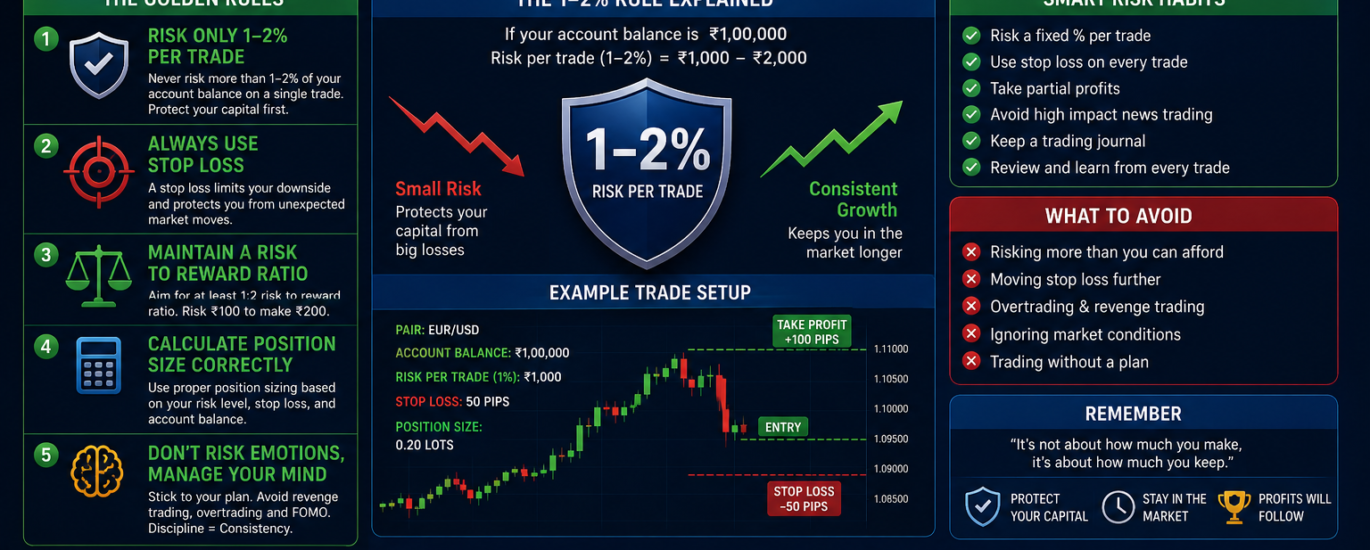
The baseline rule of professional Forex money management is restricting your risk on any single trade to a tiny fraction of your total account value. Most seasoned institutional and retail professionals adhere strictly to the 1% or 2% rule.
- The 1% Rule: If you have a $10,000 trading account, you limit your maximum possible loss on a single trade to $100.
- The 2% Rule: On the same $10,000 account, your maximum allowed risk per trade shifts to $200.
+------------------+-----------------------+-----------------------+
| Account Balance  | 1% Max Risk Per Trade | 2% Max Risk Per Trade |
+------------------+-----------------------+-----------------------+
| $2,500           | $25                   | $50                   |
| $5,000           | $50                   | $100                  |
| $10,000          | $100                  | $200                  |
| $25,000          | $250                  | $500                  |
| $50,000          | $500                  | $1,000                |
+------------------+-----------------------+-----------------------+
Implementing this strict boundary guarantees that even an extraordinary run of ten consecutive losses will only deplete roughly 10% to 17% of your total capital. This keeps you firmly in the game with ample resources to recover when market conditions align with your strategy again.
Mastering Position Sizing in Forex
Many novice traders make the critical error of keeping their lot sizes fixed, regardless of the pair they are trading or the width of their stop loss. They might trade exactly 0.1 lots on every position. This approach means your actual financial risk fluctuates wildly based on market volatility, rendering your risk strategy useless.
True position sizing in Forex requires adjusting your lot size for every trade based on two specific variables: your cash risk ceiling (e.g., $100) and the distance to your technical stop loss in pips. To determine your exact position size, utilize this fundamental formula:
$$\text{Position Size (in Units)} = \frac{\text{Amount to Risk (\text{\$})} \times \text{Exchange Rate Factor}}{\text{Stop Loss Distance (Pips)} \times \text{Pip Value}}$$
💡 Actionable Tip: Always open a digital trade risk calculator or use a reliable platform plugin before entering a market position. Input your current account balance, your chosen risk percentage, and your technical stop loss distance. Let the calculator dictate your exact lot size down to the micro-lot. Never guess your position size.
Real-World Position Sizing Example
Let us look at a practical scenario to see how this works in real-time trading conditions:
- Account Balance: $20,000
- Risk Profile: 1% of account balance ($200 maximum risk)
- Currency Pair: EUR/USD
- Trade Setup: Long entry at 1.0850 based on a strong daily support level bounce
- Technical Stop Loss: Placed just below support at 1.0810 (Distance = 40 pips)
- Pip Value (for 1 Standard Lot): $10
To find the correct lot size, divide your total risk ($200) by the product of your stop loss distance (40 pips) and the pip value ($10).
$$40 \text{ pips} \times \$10 = \$400 \text{ per standard lot}$$
$$\text{Position Size} = \frac{\$200}{\$400} = 0.5 \text{ Standard Lots}$$
By adjusting your position size to exactly 0.5 standard lots (or 50,000 units), you guarantee that if the market drops 40 pips and triggers your stop loss, you lose exactly $200—no more, no less. If a different trade setup required a wider 80-pip stop loss, you would simply drop your position size down to 0.25 standard lots to maintain the exact same $200 risk profile.
Developing a Robust Stop Loss Strategy
Types of Stop Losses
A stop loss order is an automated instruction sent to your broker to close out your market position once a specific, predetermined price level is breached. It serves as your definitive line in the sand, protecting you from catastrophic market movements. Professional traders deploy several distinct types of stop losses depending on the market framework:
- Technical Stop Loss: Placed at logical structural points on your price chart, such as just below a major swing low, above a prominent swing high, or outside a well-defined consolidation channel. This is the most reliable method because it grounds your exit in market mechanics.
- Volatility-Based (ATR) Stop Loss: Calculated using the Average True Range (ATR) indicator. By setting your stop loss as a multiple of the ATR (e.g., $2 \times \text{ATR}$), you adjust your buffer size to match the asset’s current price swings.
- Time Stop Loss: Used when a trade fails to move within a specific timeframe. If your strategy relies on immediate momentum breakouts and the market consolidates sideways for several hours, a time stop closes the trade to free up capital.
- Equity/Percentage Stop: Placed strictly at the point where your maximum cash risk limit is hit. This should only be used as an emergency backup to your technical stop loss, never as your primary method.
The Dangers of Technical vs. Mental Stops
A mental stop loss is an internal promise to manually exit a position when the market hits a certain price. In retail trading, mental stops are an open invitation to psychological failure. When the market moves against a position, human psychology naturally defaults to hope and denial. You convince yourself that the market will turn around if you just give it a few more pips.
Before you realize it, a minor loss balloons into an account-threatening disaster. A hard, broker-side stop loss order removes human emotion entirely. Once the price touches that level, the platform executes the exit instantly, independent of your fear or greed.
Dynamic Capital Management: Trailing Stops and Breakeven
As a trade moves favorably into profit, you can transition from a defensive posture to capital protection and profit harvesting.
Price Movement
  │
  ├───► Market hits Take Profit 1 (+2R) ───► Move Stop Loss to Breakeven (Lock in $0 risk)
  │
  └───► Market continues to trend ───────► Trailing Stop activates (Locks in partial profit)
Moving your stop loss to the exact breakeven entry point once a trade reaches a specific milestone (such as a 1:1 or 1:2 risk-to-reward ratio) effectively removes all financial risk from the equation. A trailing stop takes this concept further by automatically advancing behind the market price at a set distance, locking in locking in accrued profits while giving the asset room to run. However, apply these tools cautiously; moving your stop to breakeven too early often results in getting prematurely shaken out of a highly profitable long-term trend.
Maximizing Profits via Risk-Reward Ratios
The Math Behind the Risk-Reward Ratio
The risk reward ratio represents the relationship between the potential loss you accept on a trade and the potential gain you expect to achieve. It is expressed as a simple ratio, such as 1:2, meaning you are risking $1 to make $2. Understanding this metric transforms how you view success because it breaks the illusion that you need a flawless win rate to build wealth.
Let us analyze the mathematical interaction between your win rate and your risk-reward ratio to observe how profitability functions across a series of 10 trades, using a fixed $100 risk per trade:
- Scenario A (1:1 Ratio): You risk $100 to make $100. If you win 5 out of 10 trades (50% win rate), you make $500 and lose $500, ending at a flat net breakeven.
- Scenario B (1:2 Ratio): You risk $100 to make $200. If you win just 4 out of 10 trades (40% win rate), you make $800 and lose $600, leaving you with a net profit of $200.
- Scenario C (1:3 Ratio): You risk $100 to make $300. If you win only 3 out of 10 trades (30% win rate), you make $900 and lose $700, leaving you with a clean net profit of $200.
The Win Rate Fallacy
Many amateur traders obsessively search for a holy grail system that delivers an 80% or 90% win rate. Marketers frequently sell these systems to beginners, but they usually conceal a devastating flaw: a negative risk-reward profile. A system with a 90% win rate that risks $900 to make $100 will completely erase 9 successful trades the moment a single loss occurs.
Focusing on asymmetric risk-to-reward ratios ensures that your trading account can easily withstand prolonged periods of choppy market behavior without facing insolvency.
Finding the Sweet Spot
For most retail and professional traders, the optimal structural sweet spot lies between the 1:1.5 and 1:3 ratios.
Chasing ratios higher than 1:5 regularly sounds appealing, but it requires highly precise entries and extremely wide market moves. This frequently drops your win rate down into the 15% to 20% zone, which can be brutal on your trading psychology. Designing your strategy around an attainable 1:2 ratio strikes an excellent balance, giving you wide profit targets while allowing you to stay highly profitable even if you lose more than half your setups.
Managing Leverage and Margin Appropriately
Demystifying Leverage Risk in Forex
Leverage is a mechanism provided by brokers that allows you to control massive financial positions with a relatively small amount of actual capital. For example, using 1:100 leverage means a deposit of $1,000 grants you the power to control $100,000 worth of currency on the open market.
While leverage serves as an exceptional tool for maximizing capital efficiency, it is simultaneously the single biggest source of leverage risk in Forex for uneducated traders. Leverage does not change the market’s behavior; it simply amplifies the financial consequences of price movements.
High leverage magnifies your returns on winning positions, but it accelerates your losses on losing positions with identical intensity. If you maximize your broker’s leverage capacity without accounting for proper position sizing, a tiny 1% move against your trade can immediately wipe out your entire margin account balance.
Margin Calls and Stop-Out Levels
To manage leverage safely, you must maintain a clear understanding of the operational metrics inside your trading platform’s terminal window:
- Used Margin: The specific amount of capital your broker locks up as a security deposit to keep your current open positions running active.
- Free Margin: The remaining unencumbered capital left in your account that is fully available to open new trades or absorb adverse price movements in active positions.
- Margin Level Percentage: A critical health metric calculated by dividing your total Account Equity by your Used Margin, multiplied by 100.
$$\text{Margin Level \%} = \left( \frac{\text{Account Equity}}{\text{Used Margin}} \right) \times 100$$
If your trade moves into significant loss and your Margin Level drops toward your broker’s threshold (frequently 100%), you receive a Margin Call. This is an urgent system warning that your account lacks the capital required to sustain your open positions. If the market continues to deteriorate and hits your broker’s defined Stop-Out Level (often between 50% and 20%), the platform’s automated engine will systematically liquidate your open positions at current market prices to protect the broker from deficit.
[Healthy Account: High Margin Level %]
        │
        ▼ (Unmanaged losses accumulate)
[Margin Call: Warning Level reached (~100%)]
        │
        ▼ (Further adverse market movement)
[Stop-Out Level: Automated liquidation (~50% - 20%)]
Best Practices for Leverage Selection
Safe Forex trading practices require treating high leverage as a potential emergency capacity, not as a standard daily operational tool.
- Restrict your effective operational leverage (the actual ratio of your total open position sizes relative to your cash equity) to conservative bounds like 1:5 or 1:10.
- Opt for lower internal account leverage ceilings with your broker (such as 1:30 or 1:50) if you struggle with self-discipline.
- Maintain a substantial buffer of free margin at all times to ensure your positions have ample breathing room to endure temporary counter-trend volatility.
Advanced Risk Management Techniques
Drawdown Management and Recovery Protocols
A drawdown is the peak-to-trough decline in your trading account’s equity curve. Every single trader experiences drawdowns; they are an unavoidable reality of engaging with dynamic financial markets. The difference between survival and ruin lies in your structural approach to drawdown management.
When your account enters a losing streak, you must establish automated circuit breakers to protect remaining funds. For example, implement a rule that if your account equity drops by 5% within a calendar month, you immediately cut your standard risk per trade in half (e.g., from 1% down to 0.5%). If the drawdown reaches 10%, you immediately halt all live trading activities. Transition back to a demo environment or study historical charts to determine whether your strategy is misaligned with the current macro environment or if you are misinterpreting price action.
Correlated Pairs Risk
A major pitfall in portfolio Forex account management is failing to account for directional currency correlations. Many traders think they are diversifying their risk by opening three separate long positions simultaneously across EUR/USD, GBP/USD, and AUD/USD.
   ┌──► Long EUR/USD (High USD Exposure)
   │
───┼──► Long GBP/USD (High USD Exposure)
   │
   └──► Long AUD/USD (High USD Exposure)
Because all three of these major pairs move inversely to the US Dollar, they share a very high positive correlation. If the US Dollar suddenly rallies sharply across the board on an economic data surprise, all three trades will hit their stop losses at the same moment. Instead of risking a controlled 1% on one trade, you have effectively risked 3% on a single directional theme. Always verify current cross-currency correlation matrices before opening multiple positions to ensure you are not unintentionally doubling down on the same asset exposure.
News Trading and Volatility Adjustments
High-impact macroeconomic events—such as the US Non-Farm Payrolls (NFP) report, Consumer Price Index (CPI) inflation prints, and central bank interest rate decisions—introduce intense, localized volatility into the market. During these windows, spreads widen dramatically as institutional liquidity providers temporarily pull their orders from the books.
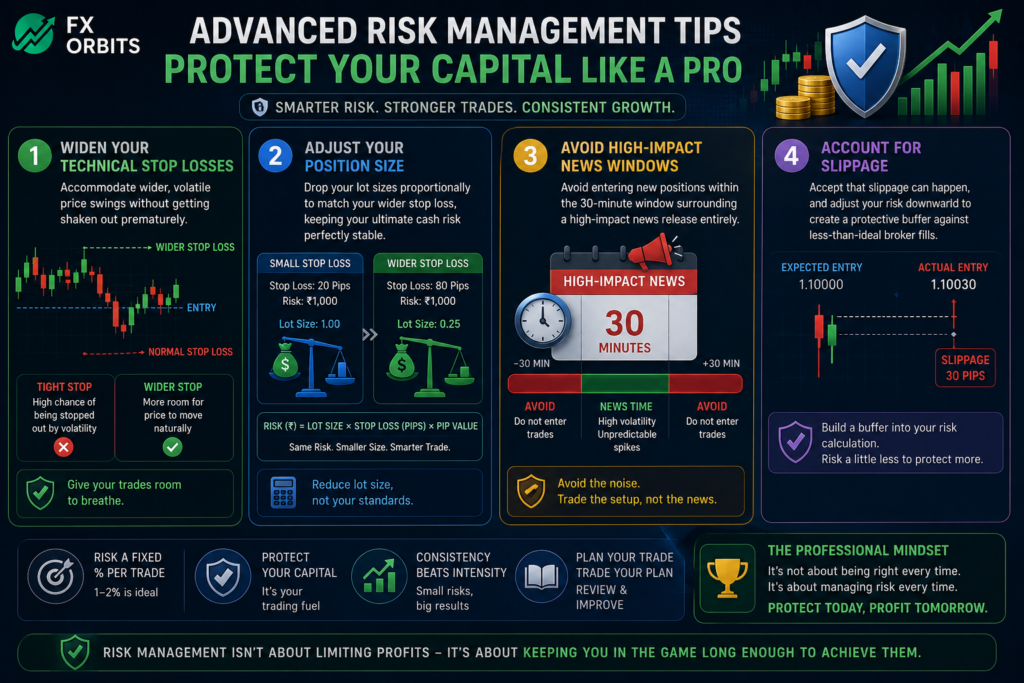
To manage risk during major news events, adopt these protective measures:
- Widen your technical stop losses substantially to accommodate wider, volatile price swings without getting shaken out prematurely.
- Drop your lot sizes proportionally to match your wider stop loss, keeping your ultimate cash risk perfectly stable.
- Avoid entering new positions within the 30-minute window surrounding a high-impact news release entirely.
- Accept that slippage can happen, and adjust your risk downward to create a protective buffer against less-than-ideal broker fills.
The Psychology of Risk: Cultivating Trading Discipline
The Psychological Core of Risk Control
You can possess an incredibly accurate technical trading strategy and an exceptionally engineered position-sizing spreadsheet, but if your mind fails under pressure, your account will follow. The root cause of most unmanaged trading losses is not lack of knowledge; it is the breakdown of emotional discipline. When real money is on the line, powerful cognitive biases like fear, greed, pride, and hope actively conspire to disrupt your execution.
+---------------+-----------------------------------+------------------------------------+
| Psychological | Trigger Event                     | Direct Negative Outcome            |
| Bias          |                                   |                                    |
+---------------+-----------------------------------+------------------------------------+
| Greed         | A string of recent wins           | Over-leveraging, inflating lot     |
|               |                                   | sizes beyond strategy limits       |
| Fear          | A recent string of losses         | Hesitating on valid entries,       |
|               |                                   | pulling stop losses closer         |
| Revenge       | A painful, unexpected loss        | Immediately re-entering with double |
|               |                                   | the size to win money back         |
| FOMO          | A sudden, rapid market breakout   | Chasing price aggressively without |
|               |                                   | a logical technical entry point    |
+---------------+-----------------------------------+------------------------------------+
Overcoming Revenge Trading and FOMO
Revenge trading is an emotional reaction where a trader attempts to instantly win back lost capital by immediately entering a new position with inflated lot sizes. This destructive loop is driven by pride and an inability to accept a loss.
FOMO, or the Fear of Missing Out, operates on a similar emotional plane, driving you to chase a price breakout that has already run its course. To overcome these cognitive traps, build structural rules into your daily routine. If you feel your pulse accelerating or notice an intense emotional reaction after a losing trade, step away from your monitors completely for at least an hour. The market will always present new opportunities; your only priority is ensuring you still have capital left to trade them.
Building a Trading Journal for Risk Optimization
A comprehensive trading journal is the ultimate tool for developing long-term Forex trading discipline. It acts as a mirror, showing you exactly where your execution diverges from your stated plan. A professional journal must track more than just your entry and exit prices; it needs to catalog the underlying risk metrics of every setup.
💡 Actionable Tip: For every trade you execute, meticulously record your planned risk-reward ratio, your exact position size, your entry emotion, your exit emotion, the maximum drawdown the trade experienced before moving into profit, and whether you adhered strictly to your plan. Review this data monthly to identify behavioral leaks and structural issues in your strategy.
Essential Risk Management Checklist
To make these principles easy to apply before every trading session, use this practical checklist. Run through these five verification steps before clicking the execute button on any platform position:
- [ ] Identify the Technical Invalidation Level: Have I located the precise structural point on the chart where this trade setup is completely wrong, and marked it with a hard stop loss?
- [ ] Calculate Account Equity Allocation: Am I risking a maximum of 1% or 2% of my current balance on this trade?
- [ ] Utilize the Trade Risk Calculator: Have I run my entry price and stop loss distance through a calculator to determine my exact lot size?
- [ ] Verify Macroeconomic Calendars: Are there any high-impact economic data releases (NFP, CPI, FOMO interest rate announcements) scheduled for this currency pair within the next two hours?
- [ ] Evaluate Personal Psychological Alignment: Am I entering this trade calmly based on a clear technical setup, or am I reacting to FOMO or recent losses?
Grow Your Digital Presence with fxorbits
Building a disciplined approach to risk is how you scale a trading account, and building a structured digital strategy is how you scale a business. At fxorbits, we specialize in crafting high-converting WordPress web designs and execution-focused SEO frameworks that help brands attract high-value clients. Our team has helped over 80 businesses grow online by turning complex search visibility challenges into clear, revenue-generating growth engines. Let us handle your digital infrastructure while you focus on scaling your core operations.
Frequently Asked Questions (FAQs)
What is the most important rule in Forex risk management?
The most critical rule is preserving your capital by limiting your financial risk to 1% or 2% of your total account balance on any single trade. This protects your account from deep, exponential drawdowns and ensures you can survive long losing streaks.
How do I calculate the correct position size for a trade?
Calculate your position size by dividing your maximum cash risk limit by the product of your technical stop loss distance in pips and the current pip value of the asset. Using a digital trade risk calculator makes this quick and accurate.
Can I trade Forex safely without using a hard stop loss order?
No, trading without a hard stop loss exposes your capital to severe, unmanaged risk. Sudden economic events or market liquidity gaps can trigger massive price swings that can wipe out an entire account within minutes if an automated exit isn’t in place.
What is a healthy risk-to-reward ratio for beginners in Forex?
A healthy risk-to-reward ratio for beginners ranges between 1:1.5 and 1:2. This gives you a balanced target that allows you to remain net-profitable even if your ultimate strategy win rate drops slightly below 50%.
How does leverage affect risk management in currency trading?
Leverage functions as a multiplier for both your gains and losses. While it increases your purchasing power, high leverage accelerates capital destruction on losing positions if you do not adjust your position sizes down proportionally.
What should I do when my trading account enters a deep drawdown?
When you enter a deep drawdown, immediately reduce your risk per trade by 50% or pause live trading entirely. Shift back to a demo account or backtest your strategy to determine if the issue stems from shifting market conditions or emotional discipline breakdowns.
How do currency correlations influence my total portfolio risk?
If you open positions in multiple pairs that share a high positive correlation (like EUR/USD and GBP/USD), you are exposed to the same underlying market theme. A sudden move can hit all your stop losses simultaneously, doubling your intended risk exposure.
Conclusion
Mastering Forex Risk Management is the defining factor that separates struggling retail amateurs from consistent, professional currency traders. You can deploy the most advanced technical indicators and chart patterns available, but without strict capital preservation rules, long-term profitability will remain out of reach. By cementing the 1% risk rule, automating your exits with hard technical stop losses, and targeting asymmetric risk-reward ratios, you protect your trading account from catastrophic drawdowns.
Success in the currency markets requires prioritizing capital preservation over chasing aggressive gains. Treat your trading capital as a valuable business asset, document your journey in a detailed journal, and let math handle the rest. Contact fxorbits today for a free SEO consultation.
