

Key Takeaways
- Legal Framework: Forex trading is completely legal in India only when done through SEBI-regulated brokers using INR-paired currency baskets.
- Permitted Pairs: Traders can legally trade specific currency pairs including USDINR, EURINR, GBPINR, and JPYINR, alongside cross-currency pairs like EURUSD, GBPUSD, and USDJPY through approved Indian exchanges.
- Account Setup: Starting out requires a registered trading and demat account linked with a bank account, backed by mandatory KYC verification.
- Risk Mitigation: Successful beginners must employ strict risk management tools like stop-loss orders and risk no more than 1–2% of capital per trade.
- Broker Selection: Avoid unregulated offshore brokers to protect capital and prevent violating FEMA regulations enforced by the RBI.
Did you know that the global foreign exchange market processes over $7.5 trillion in daily trading volume, making it the largest financial market in the world? Despite this massive global liquidity, thousands of aspiring Indian investors hesitate to step into currency trading due to a massive cloud of confusion surrounding its legalities and operational complexities. Many beginners lose their hard-earned money not because of market movements, but because they register with unauthorized offshore platforms that violate national financial regulations.
If you are wondering how to start forex trading in India safely, legally, and profitably, you have come to the right place. Navigating the intersection of international markets, local exchange rules, and regulatory frameworks can feel overwhelming. This comprehensive, step-by-step blueprint is designed to strip away the jargon and give you an actionable roadmap. By the end of this guide, you will understand exactly how the Indian forex ecosystem operates, how to choose the right platforms, and how to execute your very first legal currency trade with absolute confidence.
Understanding the Forex Market Basics
Before putting your capital on the line, you must build a solid foundational understanding of how currencies move across the globe. The foreign exchange market operates as a decentralized global network where businesses, central banks, and retail traders exchange one national currency for another.
What is Forex Trading?
Forex trading involves buying one currency while simultaneously selling another. Currencies are always traded in pairs—for example, the US Dollar against the Indian Rupee (USD/INR) or the Euro against the US Dollar (EUR/USD). When you trade forex, you are speculating on the shifting economic strength between two nations. If you believe the US economy will outperform India’s economy in the short term, you buy the USD/INR pair, expecting the dollar to appreciate against the rupee.
How Currency Pairs Work
Every currency pair consists of a base currency and a quote currency. In the USD/INR pair, the USD is the base currency, and the INR is the quote currency. The market price indicates how much of the quote currency is required to purchase a single unit of the base currency. If the USD/INR pair is trading at 83.50, it means you need 83.50 Indian Rupees to buy 1 US Dollar.
- Major Pairs: Pairs containing the USD alongside another global heavyweight (e.g., EUR/USD, GBPUSD).
- Minor Pairs: Pairs connecting major global currencies excluding the USD (e.g., EUR/GBP, EUR/JPY).
- Exotic Pairs: Pairs matching a major global currency with an emerging economy’s currency (e.g., USD/INR).
Key Terminology Every Beginner Must Know
To navigate trading platforms effectively, you need to understand the basic units of measurement used by currency traders worldwide:
- Pip (Percentage in Point): The smallest price move a currency pair can make, usually measured at the fourth decimal place.
- Spread: The difference between the buying price (bid) and the selling price (ask). This acts as the broker’s primary transaction fee.
- Leverage: A mechanism that allows you to control a large market position using a relatively small amount of actual capital. While leverage amplifies profits, it equally multiplies losses.
- Lots: The standardized unit size of a forex trade, typically divided into Standard (100,000 units), Mini (10,000 units), and Micro (1,000 units) contracts.
Is Forex Trading Legal in India? RBI and SEBI Rules Explained
The legal environment for online forex trading India is highly specific. Unlike in Western nations where retail traders can freely deposit money into international margin accounts, India maintains strict capital controls to safeguard the domestic valuation of the Indian Rupee.
The Role of RBI and SEBI
The Reserve Bank of India (RBI) controls the outflow of domestic capital under the Foreign Exchange Management Act (FEMA). Concurrently, the Securities and Exchange Board of India (SEBI) regulates the domestic brokers and financial markets that offer currency derivatives. Together, these regulatory bodies ensure that retail investors do not illegally drain India’s foreign exchange reserves through unauthorized offshore speculation.
Authorized Currency Pairs for Indian Residents
According to RBI and SEBI forex rules, Indian residents are strictly prohibited from trading spot forex via international online brokers. Instead, you can legally trade currency derivatives through recognized Indian stock exchanges like the National Stock Exchange (NSE), Bombay Stock Exchange (BSE), and Metropolitan Stock Exchange (MSEI).
| Legal Currency Pairs in India | Instrument Type | Settlement Type |
| USD/INR, EUR/INR, GBP/INR, JPY/INR | Currency Futures & Options | Cash Settled in INR |
| EUR/USD, GBP/USD, USD/JPY | Cross-Currency Futures & Options | Cash Settled in INR |
⚠️ Critical Warning: Depositing Indian rupees via credit cards, net banking, or digital wallets into international platforms (such as OctaFX, IQ Option, or Olymp Trade) is a direct violation of FEMA guidelines. Doing so can result in heavy financial penalties, account freezing, and legal prosecution.
Penalties for Illegal Offshore Trading
The RBI maintains an “Alert List” containing unauthorized forex trading platforms. Engaging with these entities means your funds are entirely unprotected. If an offshore broker freezes your capital, Indian regulatory authorities cannot assist you. Furthermore, transferring funds abroad for speculative purposes violates foreign remittance laws, exposing you to strict enforcement actions by the Directorate of Enforcement (ED).
Forex Trading for Beginners in India: Step-by-Step Setup
Setting up your trading ecosystem correctly is the most vital operational phase for a beginner. By sticking to domestic, regulated pathways, your capital remains completely secure within the Indian banking system.
[Select SEBI Broker] ➔ [Submit KYC & Bank Details] ➔ [Activate Currency Segment] ➔ [Fund Account via NetBanking]
Choosing From the Best Forex Brokers in India
To trade legally, you must open an account with a SEBI-registered stockbroker that offers access to the currency derivatives segments of the NSE and BSE. Discount brokers like Zerodha, Groww, and Angel One, alongside full-service traditional institutions like ICICI Direct and HDFC Securities, provide reliable platforms for legal currency trading in India. Look for platforms that offer stable mobile applications, low brokerage charges per order, and zero hidden maintenance fees.
Step-by-Step Forex Trading Account Setup
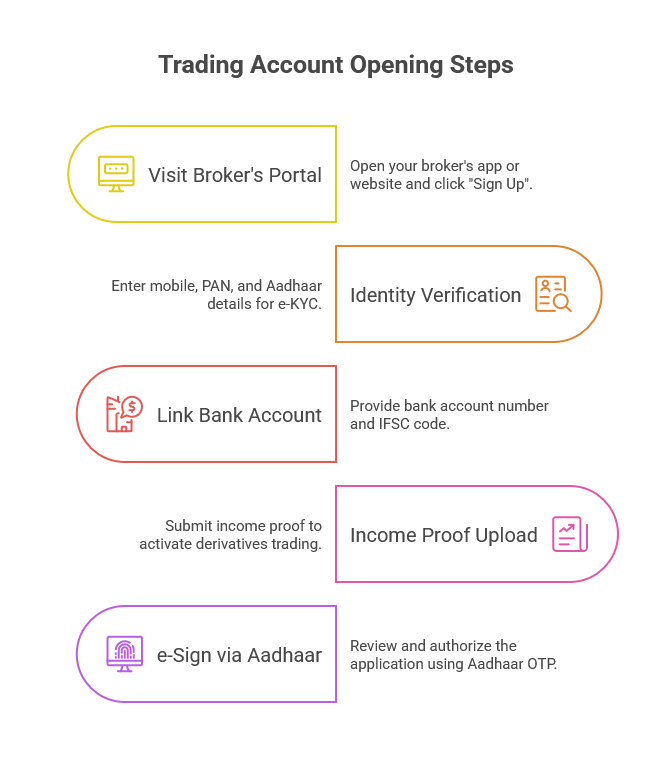
The onboarding process for an online forex trading India account is streamlined and fully digital:
- Visit the Broker’s Portal: Open your preferred SEBI-registered broker’s app or website and click on “Sign Up”.
- Identity Verification (KYC): Enter your mobile number, PAN card details, and Aadhaar card information to trigger an instant e-KYC check.
- Link Your Bank Account: Provide your bank account number and IFSC code. This will be the exclusive account used for adding and withdrawing trading capital.
- Income Proof Upload: To activate the derivatives segment (Futures & Options), Indian regulations mandate submitting a valid income proof. This can be your last six months’ bank statements, a recent salary slip, or your latest ITR acknowledgement.
- e-Sign via Aadhaar: Review your digital application and authorize it using an OTP sent to your Aadhaar-linked mobile number.
Activating the Currency Derivatives Segment
If you already possess a functional equity demat account, you do not need to create an entirely new account to study how to trade forex in India. Simply navigate to your broker’s profile console, look for the “Segment Activation” dashboard, and select “Currency Derivatives (CDS)”. Upload your latest six-month bank statement as income verification, and your broker will typically activate currency trading access within 24 to 48 hours.
Fundamental vs. Technical Analysis in Currency Markets
Consistently profitable trading requires a methodical approach to analyzing the market. Traders rely on two distinct schools of thought to predict where a currency pair’s price will move next.
       ┌────────────────────────────────────────────────────────┐
       │               FOREX ANALYSIS FRAMEWORKS                │
       └───────────────────────────┬────────────────────────────┘
                                   │
         ┌─────────────────────────┴─────────────────────────┐
         ▼                                                   ▼
┌─────────────────────────────────┐               ┌─────────────────────────────────┐
│      FUNDAMENTAL ANALYSIS       │               │       TECHNICAL ANALYSIS        │
├─────────────────────────────────┤               ├─────────────────────────────────┤
│ • RBI Interest Rate Decisions   │               │ • Candlestick Formations        │
│ • Macroeconomic GDP Growth      │               │ • Support & Resistance Levels   │
│ • Monthly Inflation Data (CPI)  │               │ • Technical Indicators (RSI/MA) │
│ • Geopolitical Events & Trade   │               │ • Historical Price Chart Patterns│
└─────────────────────────────────┘               └─────────────────────────────────┘
Master the Forex Market Basics: Economic Drivers
Fundamental analysis looks at the core economic forces that influence a country’s currency strength. Unlike single corporate equities, a country’s currency acts as a direct indicator of its overall macroeconomic health. When analyzing the USD/INR pair, you must keep a close eye on the policy announcements of both the Reserve Bank of India (RBI) and the US Federal Reserve (Fed).
- Interest Rates: Central banks use interest rates to manage domestic inflation. Higher interest rates attract global foreign investments, increasing demand for that local currency and driving its valuation upward.
- Inflation Rates: Countries experiencing persistently high inflation typically see their currency depreciate, as their local purchasing power degrades relative to international trading partners.
- GDP Growth Data: Robust gross domestic product growth indicates a highly productive economy, which boosts investor sentiment and strengthens the domestic currency.
Reading Forex Charts and Utilizing Technical Indicators
Technical analysis involves analyzing historical price charts to predict future movements. Traders look for specific patterns left behind by buyers and sellers over time. To get started with forex trading for beginners in India, familiarize yourself with Japanese candlestick charts, where each candle represents the opening, closing, high, and low prices across a selected timeframe.
- Support and Resistance: Support points to a chart level where a falling price tends to find buying interest and bounce back up. Resistance points to a level where a rising price faces selling pressure and stalls.
- Moving Averages (MA): These indicators smooth out short-term price noise to help you easily spot the broader market trend.
- Relative Strength Index (RSI): A momentum oscillator that scales from 0 to 100, signaling whether a currency pair is temporarily overbought (above 70) or oversold (below 30).
Actionable Tip: Setting Up Your Economic Calendar
💡 Actionable Tip: Download an economic calendar app like Investing.com or Forex Factory. Before entering a currency trade at the start of the day, review the calendar for high-impact announcements labeled with red flags—such as US Non-Farm Payrolls (NFP) or RBI monetary policy releases. Avoid holding active positions during these specific windows unless you are highly experienced, as volatility can spike massively within seconds.
High-Probability Forex Trading Strategies for Beginners
Having a reliable framework helps eliminate emotional bias from your trades. A clear set of rules tells you exactly when to enter and exit the market.
Trend Following Strategy
The trend following strategy operates on a simple market truth: it is safer to swim with the current than against it. Beginners can use a 50-day Exponential Moving Average (EMA) on a daily chart to find the overall market direction. If the current price trades comfortably above the 50 EMA, look only for buying opportunities. If the price remains below the 50 EMA, focus exclusively on identifying short-selling opportunities.
Support and Resistance Breakout Strategy
Market prices often consolidate within a narrow range, bounded by horizontal support and resistance lines. A breakout strategy involves waiting for the price to break cleanly through one of these established levels on strong trading volume.
Resistance ─────────────────────────────── ★ Buy Entry (Price Breaks Above)
                ▲          ▲
               / \        / \
              /   \      /   \
             /     ▼    /     ▼
Support    ───────────────────────────────
For instance, if the USD/INR pair tests a resistance level at 83.60 multiple times and finally closes above 83.62 on a 1-hour candlestick, a breakout trader enters a buy order. They anticipate that the momentum will carry the price higher toward its next major milestone.
Range Trading for Stable Markets
The USD/INR pair frequently spends weeks consolidating within a highly predictable, tight horizontal range, largely due to active market stabilization interventions by the RBI. Range traders capitalize on this predictable pattern. They buy near established support levels and sell their positions as prices approach resistance levels.
Strict Forex Risk Management and Capital Preservation
The difference between a successful currency trader and one who blows through their capital within a month comes down to disciplined risk management. If you want to learn forex trading in India sustainably, protecting your trading capital must always take priority over chasing profits.
       ┌────────────────────────────────────────────────────────┐
       │             THE PILARS OF RISK MANAGEMENT              │
       └───────────────────────────┬────────────────────────────┘
                                   │
         ┌─────────────────────────┼─────────────────────────┐
         ▼                         ▼                         ▼
┌─────────────────┐       ┌─────────────────┐       ┌─────────────────┐
│ THE 1% MAX RULE │       │    STOP-LOSS    │       │  RISK-TO-REWARD │
├─────────────────┤       ├─────────────────┤       ├─────────────────┤
│ Never risk over │       │ Set automated   │       │ Target at least │
│ 1% of total     │       │ exit triggers   │       │ a 1:2 ratio on  │
│ capital on a    │       │ to cap potential│       │ every active    │
│ single trade.   │       │ market losses.  │       │ position.       │
└─────────────────┘       └─────────────────┘       └─────────────────┘
The 1% Rule: Shielding Your Trading Capital
Never risk more than 1% of your total trading capital on any single position. If your trading account holds an active balance of ₹1,00,000, your maximum allowable loss per trade should not exceed ₹1,000. Adhering to this structural constraint ensures that even an unexpected streak of ten consecutive losing trades only draws down your account balance by 10%, leaving you with plenty of capital to recover.
Utilizing Hard Stop-Loss and Take-Profit Orders
A stop-loss order is an automated instruction that closes out your position at a predetermined price if the market moves against you. Never execute a currency trade without setting an active stop-loss order within your platform. Conversely, a take-profit order ensures that your trade automatically locks in gains as soon as the market hits your target price, preventing greed from turning a winning trade into a loss.
Calculating the Ideal Position Size
Position sizing dictates how many lots you should buy or sell based on the distance to your stop-loss order. Let us look at a practical breakdown of how this works in real market conditions:
| Capital Component | Example Scenario Metrics |
| Total Trading Account Capital | ₹2,000,000 |
| Maximum Permitted Risk (1%) | ₹2,000 |
| Trade Entry Price (USD/INR Futures) | 83.40 |
| Set Stop-Loss Price | 83.30 (Risk of 0.10 Paise) |
| Single Lot Size (NSE Contract) | $1,000 (10 Paise move = ₹100 per lot) |
| Maximum Position Allocation | 20 Lots (₹2,000 Total Risk / ₹100 Risk Per Lot) |
By checking this calculation before placing a trade, you guarantee that even if the market hits your stop-loss, your total loss stays capped right at your predetermined ₹2,000 threshold.
Practical Forex Trading Tips for Beginners
Stepping into live currency trading requires transitioning smoothly from theoretical strategies to real-world execution. Here is how to navigate your early days in the market while keeping your capital secure.
The Power of Commencing with a Demo Simulator
Before risking actual capital, leverage your broker’s paper trading features or use a free simulation platform like TradingView. Spend at least one to two months practicing inside a virtual demo account. This helps you get comfortable with the platform’s interface, test your strategies, and learn how to place buy and sell orders without any financial risk.
Keeping a Detailed Trading Journal
Documenting your progress is essential for long-term growth. Maintain a dedicated notebook or digital spreadsheet to log every trade you make. Track your entry price, exit price, the technical setup behind the move, and your emotional state during the trade. Reviewing this log over time helps you spot recurring mistakes and refine your approach.
Top Pitfalls to Avoid in Currency Trading
- Over-Leveraging: Avoid trading maximum lot sizes on a small account balance. A brief market swing against your position can wipe out your entire capital.
- Revenge Trading: Resist the urge to instantly scale up your position sizes after a loss to make your money back. This emotional reaction usually leads to even deeper losses.
- Chasing Over-Hyped Signals: Avoid joining unverified Telegram groups or WhatsApp communities that promise guaranteed daily trading signals. Focus on developing your own analytical skills so you can trade independently.
Leverage Expert Digital Solutions with fxorbits
Building a disciplined approach to the markets requires the right tools, clear data, and an optimized online workspace. At fxorbits, we have helped more than 80 businesses worldwide build robust digital platforms, deploy high-performance web solutions, and maximize their search engine visibility. Whether you are launched as an independent financial consultant or building an enterprise fintech application, our expert team provides custom WordPress web development and search engine optimization frameworks tailored to your business goals.
Frequently Asked Questions (FAQs)
Can I legally trade forex in India?
Yes, forex trading is completely legal in India, provided you trade through SEBI-registered brokers on recognized domestic exchanges like the NSE and BSE. You are legally allowed to trade currency derivatives pairs that are directly paired with the Indian Rupee (INR) or specific cash-settled cross-currency pairs.
Which currency pairs are legal to trade in India?
The legally permitted pairs include USD/INR, EUR/INR, GBP/INR, and JPY/INR. Additionally, retail traders can trade cross-currency pairs like EUR/USD, GBP/USD, and USD/JPY, provided the final settlements are processed in Indian Rupees (INR).
Can I use international brokers like OctaFX or XM in India?
No, using international offshore brokers is illegal for Indian residents under FEMA regulations enforced by the RBI. Depositing money with unauthorized international platforms via net banking or credit cards can expose you to account freezes and financial penalties.
What is the minimum capital required to start forex trading in India?
You can start trading currency futures through domestic discount brokers with as little as ₹2,000 to ₹5,000. Because Indian exchange contracts provide structured leverage, a single lot of a USD/INR contract requires a relatively small margin deposit.
When is the Indian forex market open for trading?
The currency derivatives segment on Indian stock exchanges like the NSE and BSE operates from Monday through Friday, between 9:00 AM IST and 5:00 PM IST. The market remains closed on weekends and national holidays.
Do I need a demat account for forex trading?
Yes, you need a trading account with an active currency segment enabled through a SEBI-regulated stockbroker. While currency futures contracts are cash-settled rather than physically delivered, brokers process these transactions through your integrated trading and demat setup.
How are forex trading profits taxed in India?
Profits earned from trading currency derivatives in India are treated as business income (speculative or non-speculative depending on your holding patterns). They are taxed according to your applicable personal income tax slab rates under the Income Tax Act.
Conclusion
Learning how to start forex trading in India is an accessible journey if you stick to SEBI-regulated channels. By focusing on permitted pairs like USD/INR through domestic brokerages, you protect your capital and stay fully compliant with RBI rules. Success in currency trading relies on consistent fundamental and technical analysis, combined with a disciplined risk management plan that keeps your losses small. Treat currency trading as a professional business rather than a get-rich-quick scheme, build your skills in a demo account, and scale up your positions gradually as your confidence grows.
