
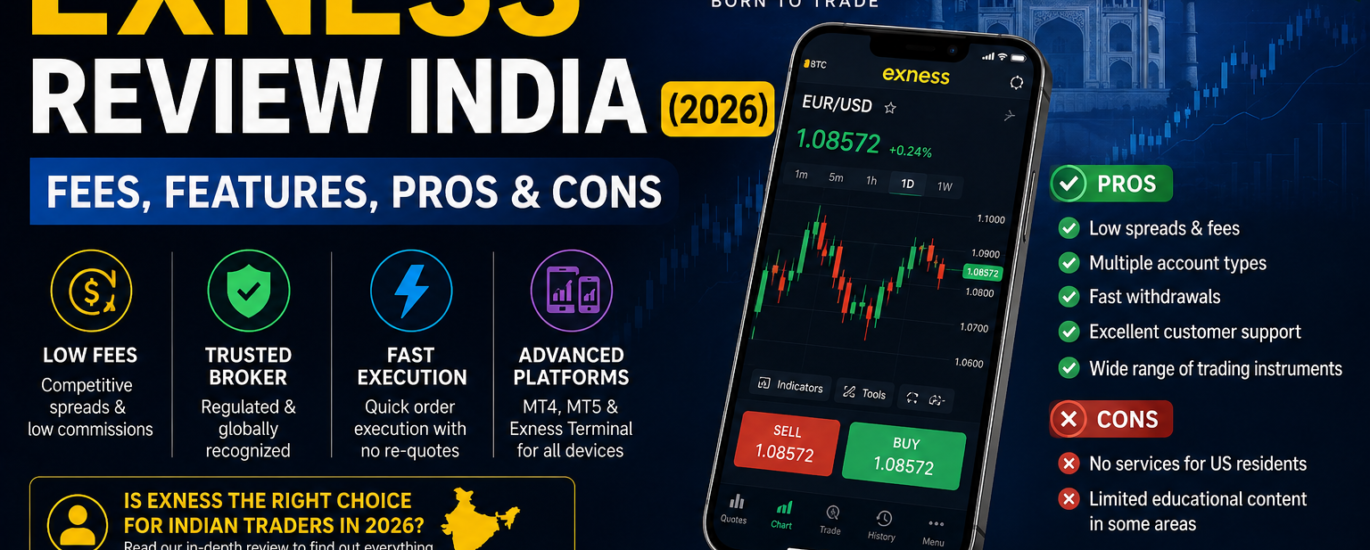
Key Takeaways
Low Entry Barrier: You can start trading with a minimum deposit of just $3 (approx. ₹250) on Standard Cent accounts, making it highly accessible.
Flexible Payment Methods: Exness supports local Indian payment options, including UPI, Netbanking, and IMPS, with zero deposit or withdrawal fees.
Competitive Spreads: Standard accounts offer spreads from 0.2 pips, while Pro, Raw Spread, and Zero accounts offer spreads starting from 0.0 pips.
Massive Leverage Options: Exness stands out in the market by offering up to 1:Unlimited leverage for qualified accounts, providing massive buying power.
Regulatory Landscape: While regulated globally by Tier-1 authorities (FCA, CySEC), Exness operates in a regulatory grey area in India as it is on the RBI Alert List.
Advanced Software Support: Seamlessly trade using MetaTrader 4 (MT4), MetaTrader 5 (MT5), or the proprietary Exness Trade mobile app.
Finding a reliable trading partner in the crowded retail forex space can feel like finding a needle in a haystack. With hundreds of platforms promising zero spreads and instant payouts, how do you separate genuine brokers from glorified marketing traps? If you are an Indian trader looking to navigate the global currency markets, this question becomes even more critical. Local restrictions, payment processing hurdles, and currency conversion costs can quickly eat into your hard-earned profits.
Enter Exness, one of the largest multi-regulated multi-asset brokers globally. In this exhaustive Exness Review India, we will pull back the curtain on this popular platform to see if it lives up to the hype.
We will break down its actual fee structure, account configurations, leverage limits, trading software performance, and local payment methods. Most importantly, we will address the regulatory reality of trading forex in India. By the end of this guide, you will have all the objective data needed to decide whether Exness is the right launchpad for your financial trading journey.
Overview of Exness as a Forex Broker in India
To understand the broker’s current standing, we must look at where it came from and how it serves local clients. Exness has positioned itself as a technology-first broker, prioritizing deep liquidity and rapid automated execution over heavy sales calls.
What is Exness and How Does It Work?
Exness is a global multi-asset brokerage firm founded in 2008. The platform operates primarily as a market maker (on its Standard accounts) and utilizes an ECN/STP execution model for its professional accounts. This means when you place a trade on the Exness trading platform, the order is either matched internally within their massive pool of retail liquidity or routed directly to Tier-1 liquidity providers (such as major global banks).
For Indian residents, the platform translates global market access into localized convenience. Traders can open an account, complete their KYC (Know Your Customer) process online, fund their accounts using standard domestic payment applications, and execute trades on major currency pairs, indices, metals, cryptocurrencies, and stock CFDs.
Evolution and Market Position in 2026
Over the last decade, Exness has grown from a boutique European broker into a global giant boasting monthly trading volumes exceeding $3 trillion. In 2026, it remains one of the preferred platforms for retail traders in the Asia-Pacific region.
This market dominance is driven by their continuous infrastructure upgrades. The broker has invested heavily in localized data servers, which drastically reduces order latency for Asian traders. While competitors often rely on manual desks to approve large withdrawals, Exness has pioneered a system of automated, instant withdrawals that run 24/7—a feature that remains a major selling point in 2026.
Quick Verdict for Indian Traders
If you are looking for tight spreads, high leverage, and a seamless mobile trading experience, Exness is difficult to beat. It is particularly suited for high-frequency scalpers and day traders who rely on fast order execution and predictable pricing.
However, beginner traders must exercise caution. The availability of ultra-high leverage can be a double-edged sword, magnifying both profits and losses. Furthermore, the legal landscape surrounding international retail forex in India requires traders to understand exactly how their capital is processed.
Is Exness Safe in India? Regulation and Security Explained
No matter how cheap a broker’s fees are, your capital’s safety should always come first. Let’s dissect the regulatory status of Exness both internationally and locally.
Global Licenses and Regulatory Status
Exness is highly regulated on the international stage. It holds operating licenses from several top-tier global financial authorities:
- Financial Conduct Authority (FCA) in the United Kingdom (Registration Number: 730729)
- Cyprus Securities and Exchange Commission (CySEC) in Europe (License Number: 178/12)
- Financial Sector Conduct Authority (FSCA) in South Africa
- Financial Services Authority (FSA) in Seychelles
These bodies require strict capital adequacy ratios, regular third-party audits, and the separation of corporate funds from client trading capital. This ensure that even if the broker faces financial distress, your trading capital remains untouched in segregated bank accounts.
The Legality of Forex Trading under FEMA and RBI Guidelines
Here is where we need to address a critical point for Indian residents. The Exness Forex Broker India setup operates in a regulatory “grey area.”
According to the Foreign Exchange Management Act (FEMA) and the Reserve Bank of India (RBI) guidelines, retail spot forex trading through international, non-SEBI-regulated online brokers is unauthorized. The RBI maintains an “Alert List” of entities that are not authorized to deal in foreign exchange under FEMA. Exness, along with almost all other major international brokerages (such as Octa, XM, and AvaTrade), is included on this list.
Trading on these platforms is done at the resident’s own risk. Under local laws, you are legally permitted to trade currency derivatives on domestic Indian exchanges like the NSE and BSE (such as USD/INR, EUR/INR pairs) through SEBI-registered brokers. If you choose to trade via offshore brokers like Exness, you will not have access to local investor protection funds or regulatory dispute resolution schemes if things go wrong.
How Exness Protects Client Funds
To offset these geographical risks, Exness implements top-tier technical security protocols. They use advanced encryption standards to secure transactions and user data. Furthermore, they are a member of the Financial Commission—an international independent organization specializing in dispute resolution for financial markets. This membership offers a compensation fund of up to €20,000 per client in the event of an unresolved dispute, providing an extra layer of peace of mind for Indian retail traders.
Exness Account Types: Choosing the Right Option
One of Exness’s biggest strengths is its diverse portfolio of accounts. Whether you are a retail beginner starting with pocket change or a veteran algorithmic trader, there is an account type optimized for your strategy.
┌────────────────────────────────────────────────────────┐
│               EXNESS ACCOUNT ARCHITECTURE              │
├───────────────────────────┬────────────────────────────┤
│     STANDARD ACCOUNTS     │    PROFESSIONAL ACCOUNTS   │
│   (Beginners & Casual)    │   (Advanced & Scalpers)    │
├───────────────────────────┼────────────────────────────┤
│ • Standard                │ • Pro                      │
│ • Standard Cent           │ • Raw Spread               │
│ • Low Min Deposit ($3)    │ • Zero                     │
│ • No Commissions          │ • Ultra-low Spreads        │
└───────────────────────────┴────────────────────────────┘
Standard and Standard Cent Accounts for Beginners
For most retail investors starting out, the Exness Account Types in the “Standard” tier are the most practical entry point.
- Standard Cent Account: This account uses “cents” as its base unit (1 USD = 100 US Cents). It is designed specifically for Exness for beginners who want to transition from a risk-free demo environment to real market conditions without risking substantial capital. You can open this account with a minimum deposit of just $3 (depending on the payment provider).
- Standard Account: This is the most popular account on the platform. It offers market execution, has no trading commissions, and provides spreads starting from an average of 0.2 to 0.3 pips on major pairs. It is highly versatile and works perfectly for standard day trading strategies.
Professional Accounts (Pro, Raw Spread, and Zero)
If you are an experienced trader, run Automated Trading Advisors (EAs), or scalp on short-term price movements, the professional accounts offer vastly superior pricing structures. These accounts require a higher initial minimum deposit of $200:
- Pro Account: This account offers instant execution for most instruments, meaning no slippage on stable market entries. It is a “spread-only” account with zero commissions, starting at around 0.6 pips.
- Raw Spread Account: This mimics direct market feeds. It offers raw market spreads (averaging 0.0 pips on EUR/USD) and charges a flat, low commission of $3.50 per side ($7 per round lot).
- Zero Account: Exness guarantees zero spreads for the top 30 trading instruments for 95% of the trading day. In exchange, you pay a variable commission starting from $3.50 per side ($7 per round lot), which can scale higher for minor or exotic pairs.
Demo Accounts and Swap-Free (Islamic) Settings
If you aren’t ready to commit real money, Exness provides unlimited, free demo accounts pre-loaded with virtual currency. This allows you to test the execution speeds of both MT4 and MT5 under real-world conditions.
Additionally, Exness offers swap-free accounts (Islamic accounts) automatically for residents of Islamic countries and on an extended basis for other regions. This means you do not pay or earn overnight interest (rollover fees) when keeping positions open past the daily market close, which is a major advantage for swing traders who hold trades for weeks.
Exness Fees India: Spreads, Commissions, and Overnight Charges
Trading costs can quietly decimate a profitable trading strategy over time. Let’s look at the actual Exness Fees India structure so you know exactly what to expect.
| Account Type | Minimum Deposit | Average Spread (EUR/USD) | Commission (Per Round Lot) | Best Suited For |
| Standard Cent | $3 | From 0.3 pips | $0 (No Commission) | Absolute Beginners |
| Standard | $10 | From 0.2 pips | $0 (No Commission) | Casual Day Traders |
| Pro | $200 | From 0.6 pips | $0 (No Commission) | Experienced Swing Traders |
| Raw Spread | $200 | From 0.0 pips | $7.00 Flat | Scalpers & Algorithmic EAs |
| Zero | $200 | 0.0 pips (Guaranteed) | From $7.00 (Variable) | News Traders & Scalpers |
Spread Structure Across Different Accounts
The Exness Spread and Commission structure is highly competitive compared to industry averages. On standard retail accounts, the spread floats dynamically based on liquidity. During highly liquid market hours (such as the overlap of the London and New York sessions), EUR/USD spreads can drop to 0.5–0.7 pips, which is lower than the typical 1.2 pips charged by standard offshore brokers.
Commission Rates Explained
With the Raw Spread and Zero accounts, you exchange higher spreads for direct execution and commissions. The commission of $7.00 per round lot is highly transparent and ranks among the lowest in the retail broker space.
Actionable Tip: If you execute more than 50 trades a week, choose the Raw Spread account over the Standard account. The minor commission fee you pay is significantly cheaper than paying the spread markup on every single entry and exit.
Hidden Fees and Inactivity Costs
One major benefit of Exness is its user-friendly fee policy outside of active trading:
- No Deposit/Withdrawal Fees: Exness does not charge you for moving money in or out of your account.
- Zero Inactivity Fees: Unlike other brokers who penalize you if you take a break from trading, Exness does not charge any monthly maintenance or inactivity fees on dormant accounts.
Exness Deposit and Withdrawal Options for Indian Traders
For Indian traders, getting money into and out of an offshore trading account is often the most stressful part of the process. Exness addresses this friction point with localized payment systems.
Supported Local Payment Methods (UPI, Netbanking)
The Exness Deposit and Withdrawal mechanism supports standard Indian transaction channels:
- UPI (Unified Payments Interface): You can use Google Pay, PhonePe, Paytm, or BHIM to instantly transfer funds to your trading account. The minimum deposit via UPI is typically around ₹1,000 to ₹1,500.
- Local Netbanking / IMPS: Direct transfers from major Indian banks (SBI, HDFC, ICICI, Axis Bank) are fully supported.
- Cryptocurrencies: For advanced users, Exness supports deposits and withdrawals via Bitcoin (BTC) and Tether (USDT-ERC20 or USDT-TRC20), bypassing domestic banking delays entirely.
Withdrawal Processing Speed and Limits
Exness is famous for its instant withdrawal system. On most payment methods, once you submit a withdrawal request in your Personal Area (PA), the transaction is processed automatically by an algorithm rather than a finance team member.
For UPI and Netbanking, the money typically reflects in your local Indian bank account within 1 to 3 hours, although it can sometimes take up to 24 hours during peak banking traffic. Cryptocurrency withdrawals are processed within minutes.
Step-by-Step Guide to Fund Your Exness Account Safely
To ensure smooth processing and prevent compliance flags, follow this sequence:
1.Complete Profile Verification (KYC):Takes up to 24 hours.
Before uploading funds, upload high-resolution photos of your Proof of Identity (POI) (Aadhaar Card, PAN Card, or Passport) and Proof of Address (POA) (Bank Statement or utility bill).
2.Navigate to the Deposit Section:In your Personal Area.
Log in to your Exness account dashboard, go to the Deposit tab, and select UPI or Local Bank Transfer as your preferred payment gateway.
3.Input Amount and Match Names:Ensure names match exactly.
Specify your deposit amount in Indian Rupees (INR). Crucial Rule: The bank account or UPI ID used must be in your exact name. Exness strictly prohibits third-party deposits.
4.Complete the Payment Gateway Prompt:Follow on-screen instructions.
You will be redirected to a payment screen showing a UPI VPA or bank account detail. Complete the transfer from your banking app, take a screenshot of your payment receipt (UTR/transaction ID), and upload it if prompted to complete the transaction.
Exness Trading Platforms and App Performance
Exness offers a rich suite of trading platforms that cater to all styles of trading, from mobile-first retail users to high-performance desktop traders.
MetaTrader 4 (MT4) vs MetaTrader 5 (MT5) Integration
The broker provides flawless integration with both standard industry platforms:
- MetaTrader 4 (MT4): This remains the gold standard for forex-only day traders and automated EA developers. It is lightweight, extremely stable, and features thousands of free custom indicators.
- MetaTrader 5 (MT5): MT5 is the modern successor of MT4. It supports multi-asset trading (stocks, futures, cryptos, and forex), features an integrated economic calendar, and has superior backtesting engines for quantitative traders.
Exness supports both platforms across Windows, macOS, Android, and iOS.
The Proprietary Exness Terminal and Web Interface
If you do not want to download software to your desktop, the Exness Terminal is a highly capable web-based alternative. It is built directly on TradingView charts, meaning you have access to clean drawing tools, dozens of indicators, and a modern, visually appealing interface. It is highly responsive and runs smoothly inside any modern web browser.
Mobile Experience: The Exness Trading App Review
For traders on the go, the Exness Trading App Review is overwhelmingly positive. The proprietary “Exness Trade” app is a massive step up from the basic MT4 mobile app.
It allows you to manage your accounts, deposit/withdraw funds, analyze charts using built-in technical indicators, and execute trades all within a single application. The layout is highly intuitive, fast, and features real-time notifications for price alerts and market movements.
Exness vs Competitors: Exness vs Octa and Exness vs XM
How does Exness stack up against its two biggest rivals in the Indian market? Let’s run a direct comparison to see who wins in key categories.
Detailed Comparison of Trading Costs
When comparing Exness vs Octa and Exness vs XM, Exness consistently edges out its competitors on raw spread costs. While XM has excellent micro accounts, their standard spreads on EUR/USD average 1.5 pips, compared to Exness’s average of 0.9 pips on Standard accounts. Octa offers highly competitive fees, but their professional raw spread configurations are not as robust or consistently tight as Exness’s Raw Spread account.
Platform Reliability and Execution Speed
In terms of execution model, Exness is superior for high-volume traders because of its deep institutional liquidity pools. While all three brokers offer MT4 and MT5, Exness’s proprietary web terminal and mobile trade app are more polished and user-friendly than Octa’s proprietary app. Additionally, Exness’s automated withdrawal system works substantially faster than XM’s manual finance review process, which can take up to 24 hours.
Customer Support and Education Resources in India
- Exness: Offers 24/7 localized Exness Customer Support India via live chat, email, and phone. Their help center has comprehensive Hindi documentation and support agents.
- Octa: Strong in localized contest giveaways and local seminars, but live chat support can occasionally have long wait times during volatile market sessions.
- XM: Excellent educational webinars and daily market analysis rooms, which are highly beneficial for beginners trying to learn fundamental and technical analysis.

Growing Your Online Presence with fxorbits
Are you looking to build a high-converting affiliate website, a trading blog, or a premium corporate platform for your financial services brand? Navigating the complex digital landscape of SEO and professional web design requires the same precision as a successful forex trade.
FAQ Section
Is Exness legal to use for trading in India?
Exness operates in a regulatory grey area in India. It is not licensed by SEBI, the domestic regulatory authority, and is currently featured on the RBI’s unauthorized alert list. While Indian residents can register and trade at their own discretion, they do so without local regulatory protections or legal recourse under FEMA guidelines.
What is the minimum deposit for Exness in India?
The minimum deposit on Exness depends entirely on the account type and payment processor you select. For a Standard Cent account, you can start with as little as $3 (approx. ₹250). For Professional accounts (Pro, Raw Spread, Zero), the initial deposit starts at $200.
How fast are withdrawals on Exness for Indian users?
Exness uses an automated withdrawal processing system that works instantly 24/7. For local payment methods like UPI or Netbanking, funds are typically credited to your Indian bank account within 1 to 3 hours, making it one of the fastest processing brokers in the market.
Can I use UPI to deposit and withdraw money on Exness?
Yes, Exness fully supports UPI as a localized payment method for Indian clients. You can easily deposit and withdraw funds using standard apps like Google Pay, Paytm, or PhonePe, provided that the UPI account is registered under your exact verified name.
What is the maximum leverage available on Exness India?
Exness offers flexible leverage options starting from 1:200 and reaching up to a massive 1:Unlimited leverage for MT4 accounts. To unlock unlimited leverage, traders must meet specific conditions, including completing a minimum number of trades and maintaining a balance below $1,000 to prevent extreme risk exposure.
Does Exness charge commissions on Standard Accounts?
No, Exness Standard and Standard Cent accounts are completely swap-free and charge zero commission fees on trades. Instead, the broker’s compensation is built directly into the floating spread, which remains highly competitive relative to other retail brokerages.
What is the difference between Raw Spread and Zero accounts?
The Raw Spread account features raw market spreads (starting at 0.0 pips) with a fixed commission of $7 per round lot. The Zero account guarantees zero spreads on the top 30 instruments for 95% of the day, but charges a variable commission starting from $7 and scaling higher based on the asset.
Conclusion
Exness Review India stands out as one of the most technologically advanced and cost-effective brokers available to Indian retail traders in 2026. By offering incredibly low minimum deposits, competitive zero-spread accounts, instant automated withdrawals, and localized UPI payment support, they have successfully eliminated the primary operational friction points that retail traders face daily.
However, trading on an offshore platform requires a clear understanding of the regulatory landscape and the strict management of high leverage options. If you prioritize fast execution, stellar mobile trading, and ultra-low spreads, Exness remains an exceptional choice.
