
Key Takeaways
- Market Scale: The foreign exchange market is the largest financial market globally, trading over $7.5 trillion daily, offering unmatched liquidity and 24/5 access.
- Currency Pairs: Forex trading always involves buying one currency and selling another simultaneously, categorized into major, minor, and exotic pairs.
- Risk Control: Successful beginners prioritize risk management tools like stop-loss orders and never risk more than 1% to 2% of their account equity on a single trade.
- Practice First: Utilizing a free forex demo account allows you to build skills, test strategies, and understand market mechanics without risking real capital.
- Strategy Matters: Developing a consistent strategy using technical or fundamental analysis is essential to navigate volatile market shifts successfully.
- Broker Selection: Choosing a regulated broker ensures your capital remains safe while providing competitive spreads and robust trading platforms.
Forex Trading for Beginners: Everything You Need to Know Before Starting
Imagine a marketplace that never sleeps, where over $7.5 trillion changes hands every single day. That is the global foreign exchange market. For many newcomers, entering this massive financial arena feels like stepping into a complex labyrinth. The sheer volume of shifting numbers, technical charts, and economic announcements can quickly become overwhelming. This steep learning curve causes many novice traders to lose money within their first few weeks.
However, Forex Trading for Beginner scurrencies does not have to be an encrypted mystery. With the right educational foundation, a clear strategic roadmap, and disciplined habits, you can navigate this space confidently. This comprehensive manual simplifies the core concepts of the currency market. You will discover exactly how prices move, how to execute your first transaction, and how to protect your hard-earned capital. Whether you want to build a secondary income stream or understand global economics better, this guide provides the practical knowledge required to launch your journey successfully. Let us demystify the mechanics of currency markets and set you on the path to financial literacy.
Understanding the Foundations of the Forex Market
What is Foreign Exchange?
Foreign exchange, commonly known as forex or FX, is the decentralized global marketplace for exchanging national currencies against one another. Unlike traditional stock exchanges that operate within fixed geographic boundaries, this market functions electronically through a global network of banks, corporations, institutional investors, and individual retail traders. When you travel internationally and swap your local currency for foreign banknotes, you participate in the foundational concept of this network. In the digital trading arena, participants capitalize on the continuous fluctuations in value between these global currencies.
How the Forex Market Works
The mechanics of this financial system rest on the principles of supply and demand. Currency values shift constantly based on corporate cross-border transactions, central bank policies, tourism, and geopolitical stability. The market operates 24 hours a day, five days a week, moving through four major international trading sessions: London, New York, Sydney, and Tokyo. Because these sessions overlap across time zones, you can execute trades at any hour of the day or night from Monday through Friday. This constant accessibility creates a highly liquid environment where buyers and sellers connect instantly.
The Role of Central Banks and Institutions
Large financial entities dictate the broader direction of currency values. Central banks, such as the Federal Reserve in the United States or the European Central Bank in the Eurozone, wield immense influence by adjusting interest rates and managing monetary policy. When a central bank raises interest rates, its national currency often strengthens because foreign investors seek higher returns on assets denominated in that currency. Commercial banks, multinational corporations, and hedge funds also execute massive institutional transactions daily, creating the foundational price movements that retail traders analyze and follow.
| Market Characteristic | Stock Market | Forex Market |
| Daily Trading Volume | ~ $200 – $300 Billion | Over $7.5 Trillion |
| Trading Hours | Fixed Exchange Hours (e.g., 9:30 AM – 4:00 PM) | 24 Hours a day, 5 days a week |
| Centralization | Centralized (e.g., NYSE, NASDAQ) | Decentralized (Over-the-Counter) |
| Transaction Fees | Commissions and exchange fees | Built into the spread |
| Market Focus | Thousands of individual company stocks | Main focus on 8-10 major currencies |
Essential Forex Trading Terminology
Deciphering Currency Pairs
In this marketplace, currencies are always quoted in pairs because you are simultaneously buying one asset while selling another. The first currency listed in the pair is the base currency, while the second is the quote currency. For example, in the EUR/USD pair, the Euro is the base and the US Dollar is the quote. If the exchange rate displays 1.1000, it signifies that you need exactly 1.10 US Dollars to purchase a single Euro.
Currencies are classified into three primary groups:
- Major Pairs: These pairs always feature the US Dollar coupled with another dominant global currency (e.g., EUR/USD, GBP/USD, USD/JPY). They offer the highest liquidity and the lowest transactional costs.
- Minor Pairs: Also known as cross-currency pairs, these involve major global currencies but omit the US Dollar entirely (e.g., EUR/GBP, GBP/JPY, AUD/NZD).
- Exotic Pairs: These pair a major currency with an asset from a developing or emerging economy (e.g., USD/SGD, EUR/TRY). They feature lower liquidity and significantly higher costs to trade.
Understanding Pips, Spreads, and Lots
A pip (Percentage in Point) represents the smallest incremental price move that a currency pair can make. For most pairs, a pip corresponds to the fourth decimal place ($0.0001$), though Japanese Yen pairs are an exception, measuring pips at the second decimal place ($0.01$).
The spread is the difference between the buy price (ask) and the sell price (bid) offered by your broker. This difference represents the primary cost of executing your transaction.
Trading volume is measured in lots. A standard lot represents 100,000 units of the base currency. Because this volume requires significant capital, brokers provide mini lots (10,000 units) and micro lots (1,000 units), allowing individuals to participate with modest accounts.
Leverage and Margin Explained
Leverage allows you to control larger market positions using a small fraction of your own capital. When a broker offers 1:100 leverage, you can command a $100,000 position while holding only $1,000 in your account. The money required to open and maintain that leveraged position is called the margin. While leverage magnifies your profit potential when the market moves in your favor, it equally amplifies your losses if the market moves against you. Managing this tool properly determines whether an account survives over the long term.
💡 Actionable Tip: If you are managing a small retail account, start by using micro lots (0.01 lots). This keeps your cost per pip at roughly $0.10 for most major pairs, ensuring that early analytical mistakes do not devastate your capital balance.
How to Start Forex Trading Step by Step
Step 1: Commit to Comprehensive Education
Before risking real money, dedicate time to high-quality forex trading education. Understand the underlying economic factors that drive global markets, study historical chart patterns, and read analytical breakdowns daily. Treating this practice like a serious academic discipline rather than a casual game builds the mental framework required to interpret complex market environments systematically.
Step 2: Choose a Regulated Broker
Your broker is your gateway to the international currency arena. It is vital to select a firm regulated by top-tier financial authorities, such as the Financial Conduct Authority (FCA) in the UK, the Australian Securities and Investments Commission (ASIC), or equivalent domestic regulators. Regulatory oversight ensures your deposits are kept in segregated bank accounts and that the broker executes your trades transparently without manipulative price interventions. Look for platforms that feature low spreads, zero hidden withdrawal fees, and responsive client support teams.
Step 3: Utilize a Forex Demo Account
Never fund a live account immediately. Every reputable broker provides a free forex demo account loaded with virtual currency. This practice environment mimics real-world market movements perfectly, allowing you to master the trading platform, practice order execution, and test strategies without any financial risk. Spend at least one to two months refining your approach in a simulated environment until you demonstrate consistent profitability.
Step 4: Fund Your Account Responsibly
Once you achieve stable results on the simulator, transition to a live forex trading account. Begin by depositing only risk capital—money you can lose entirely without impacting your housing, bills, or lifestyle safety net. Avoid the temptation to deposit large sums initially; instead, start small, prove you can manage real emotions under pressure, and scale your balance upward gradually as your competence grows.
[Select a Regulated Broker]
          │
          ▼
[Open a Free Demo Account] ──► Practice for 1-2 Months
          │
          ▼
[Develop a Simple Strategy] ──► Test Risk Management Rules
          │
          ▼
[Fund a Live Account Minimally] ──► Trade with Small Micro Lots
Analyzing the Markets: Fundamental vs. Technical Analysis
Fundamental Analysis: Tracking Economic Drivers
Fundamental analysis looks at the underlying economic health of a nation to predict its currency’s future value. When you follow this approach, you closely monitor macroeconomic indicators, central bank announcements, employment statistics, and gross domestic product (GDP) prints.
For instance, if the Bureau of Labor Statistics publishes a strong employment report for the United States, it signals economic strength. This data often prompts expectations of higher interest rates, which frequently drives global investors to purchase US Dollars. Learning to read an economic calendar is a mandatory skill for interpreting these periodic market updates.
Technical Analysis: Studying Price Charts
Technical analysis focuses entirely on historical price data displayed on charts. Traders who favor this method believe that all known fundamental information is already calculated into the currency’s current market price. They use historical price patterns, support and resistance zones, and mathematical indicators to predict where value will move next.
By analyzing candlestick charts, you can identify trend directions and locate optical turning points where buyers or sellers historically dominate the market.
Popular Technical Indicators for Newcomers
- Moving Averages (MA): These lines smooth out price fluctuations over a set timeframe, helping you identify the clear direction of the primary market trend.
- Relative Strength Index (RSI): A metric that scales from 0 to 100, showing whether a currency pair is overbought (above 70) or oversold (below 30).
- Average True Range (ATR): An indicator that measures overall market volatility, showing how much an asset moves on average during a specific period.
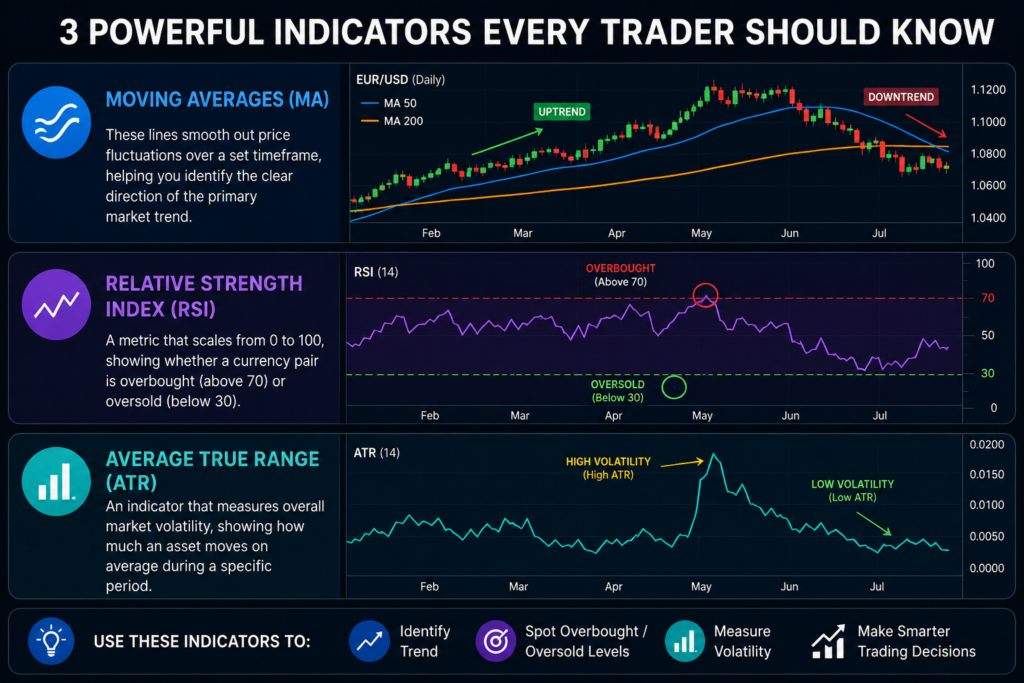
📊 Real-World Example: Consider a situation where the EUR/USD pair drops steadily toward a major historical support level of 1.0500. A technical trader looks at the chart and notices the RSI has dropped down to 25, indicating oversold conditions. Concurrently, a bullish candlestick pattern forms right at that support floor. Recognizing these combined signals, the trader executes a buy order, anticipating that the downward momentum has exhausted itself and a upward reversal is imminent.
Best Forex Trading Strategies for Beginners
Trend Trading: Riding the Momentum
Trend trading is one of the most reliable methods for beginners. It relies on a simple market philosophy: identify the general direction of the market and execute trades aligned with that momentum. In an uptrend, prices create higher highs and higher lows, meaning you look for entry points to buy when prices pull back slightly. In a downtrend, characterized by lower highs and lower lows, you look to sell during temporary relief rallies. This approach keeps you from trying to predict tops or bottoms blindly.
Uptrend Structure:
              (High)               (Higher High)
               /\                       /\
              /  \                     /  \
             /    \   (Higher Low)    /    \
            /      \       /\        /      \
           /        \     /  \      /        \
          /          \   /    \    /          \
         /            \/       \  /            \
  (Start)                       \/
                         [Optimal Buy Zone]
Support and Resistance Strategy
This strategy focuses on key price zones where an asset has repeatedly changed direction in the past. Support acts as a floor that keeps prices from falling further, where buying interest typically overcomes selling pressure. Resistance acts as a ceiling that prevents prices from rising higher, where sellers generally overpower buyers. By drawing horizontal zones across these historical turning points on your chart, you can plan clear entries: buying near support floors and selling near resistance ceilings.
Breakout Trading: Catching the Big Moves
Breakout trading involves identifying a currency pair that has consolidated within a narrow price range or chart pattern for an extended period. When the price breaks cleanly out of this boundary, it often triggers a strong surge in volume and momentum. Traders using this approach enter positions immediately after the breakout occurs, aiming to ride the resulting expansion in price. It requires quick execution and strict discipline to avoid entering false breakouts that quickly reverse.
Strict Forex Trading Risk Management
The Core Pillars of Risk Control
Preserving your capital is significantly more important than generating immediate profits. The primary reason amateur traders fail is not poor strategy, but a lack of structural risk management. Without strict guidelines, a short string of consecutive losses can wipe out an entire trading account.
By implementing structured rules, you ensure that no single analytical mistake compromises your financial stability. Developing an edge in the markets takes time, and risk management is the protective shield that keeps you solvent while you gain experience.
Practical Steps to Protect Your Capital
- Implement the 1% Rule: Never risk more than 1% to 2% of your total account balance on a single trade. If your account holds $5,000, your maximum loss on any transaction should never exceed $50.
- Always Use a Stop-Loss Order: A stop-loss is an automated instruction set within your platform that closes your position immediately if prices move against you to a specified level. This prevents catastrophic losses during unexpected market movements.
- Set a Take-Profit Target: Establish a clear target where your trade will close automatically once it reaches your profit goal, removing emotion from the exit process.
- Maintain a Realistic Risk-to-Reward Ratio: Aim for a minimum ratio of 1:2. This means that for every dollar you risk, you stand to make two dollars in return. Maintaining this dynamic allows you to remain profitable overall even if you lose half of your total trades.
| Balance | Risk Percentage | Maximum Cash Risk | Stop-Loss Target (Pips) | Allowed Lot Size |
| $1,000 | 1% | $10 | 20 Pips | 0.05 Micro Lots |
| $2,000 | 1% | $20 | 20 Pips | 0.10 Micro Lots |
| $5,000 | 1% | $50 | 25 Pips | 0.20 Micro Lots |
| $10,000 | 1% | $100 | 50 Pips | 0.20 Micro Lots |
Psychological Discipline and Avoiding Common Mistakes
Managing Emotions: Fear and Greed
Navigating live markets challenges your emotional discipline. When real money is on the line, greed often drives traders to over-leverage or break their rules to chase larger profits. Conversely, fear can cause you to cut winning trades early or hesitate to enter valid setups.
Accepting that losses are a normal cost of doing business helps reduce these emotional swings. Maintaining a calm, objective mindset allows you to execute your plan consistently, regardless of short-term outcomes.
The Pitfalls of Revenge Trading and Over-Trading
Revenge trading happens when you suffer an unexpected loss and immediately enter a new, unplanned position to win back the lost money. This emotional reaction usually leads to larger losses because it lacks analytical backing.
Over-trading is a similar pitfall where you execute transactions out of boredom or a felt need to be active in the market constantly. Professional trading requires patience—waiting for high-probability setups to emerge rather than forcing trades when conditions are poor.
Keeping a Detailed Trading Journal
A trading journal is a valuable tool for building long-term discipline. Document every transaction you execute, noting the entry price, stop-loss level, exit point, and the specific strategic reasons behind the setup.
Include screenshots of the chart layout and record your emotional state during the process. Reviewing these logs monthly helps you identify recurring analytical mistakes, highlight strategic strengths, and track your development as a trader.
Navigating the Contemporary Forex Landscape
As you embark on your journey, building a reliable digital foundation is essential. Navigating complex platforms, optimizing data feeds, and ensuring your online presence functions seamlessly requires expert technical support. If you want to build a highly visible brand or scale an online venture, our team at fxorbits is here to help. We have empowered over 80 businesses to scale online by designing premium, high-converting digital platforms and implementing tailored SEO strategies that drive sustainable organic growth.
Frequently Asked Questions (FAQs)
Can I start forex trading with only $100?
Yes, you can begin with as little as $100. Many regulated brokers offer specialized micro or nano accounts that allow for tiny position sizes. Starting small keeps your real-world risk minimal while you learn how to manage live trades and master the platform mechanics.
Is forex trading safe for complete beginners?
Forex trading carries substantial financial risk due to market volatility and leverage. It is safe only if you commit to thorough education, practice on a simulated demo account first, and apply strict risk controls, such as risking no more than 1% of your balance per trade.
How many hours a day should a beginner spend trading?
Beginners do not need to watch charts all day. Dedicating one to two hours daily to focused analysis, reviewing economic calendars, and tracking key sessions is highly effective. Quality analysis and patience are far more valuable than spending long, unproductive hours in front of a screen.
What is the most profitable currency pair to trade?
There is no single most profitable currency pair, but the EUR/USD is highly recommended for beginners. It features the highest liquidity, the lowest transactional spreads, and behaves more predictably than minor or exotic pairs, making it excellent for practicing technical strategies.
What is the difference between leverage and margin?
Margin is the initial deposit or collateral required to open and maintain a trading position. Leverage is the tool provided by your broker that allows you to borrow capital against that margin, enabling you to control much larger positions than your actual account balance would allow.
How long does it take to learn forex trading?
Learning the basic terminology and mechanics takes a few weeks, but achieving consistent profitability typically requires six months to a year of deliberate practice. It takes time to develop emotional discipline, master risk management, and understand how strategies perform across changing market conditions.
Do I need expensive software to trade forex online?
No, you do not need expensive software. Most reputable brokers provide free access to professional trading platforms like MetaTrader 4, MetaTrader 5, or TradingView. These industry-standard platforms include all the essential charting tools, indicators, and order execution options required to analyze markets effectively.
Conclusion
Mastering forex trading for beginners requires a balanced combination of structured education, strategic patience, and disciplined risk management. Success in this global marketplace does not come from finding a flawless indicator or chasing overnight wealth. Instead, it relies on managing your risk effectively, learning from a demo environment, and executing a consistent strategy with emotional discipline. By protecting your capital and continually refining your skills, you can navigate this high-volume financial arena safely. Treat your trading as a long-term business endeavor, and focus on steady, sustainable progress.
