
Key Takeaways
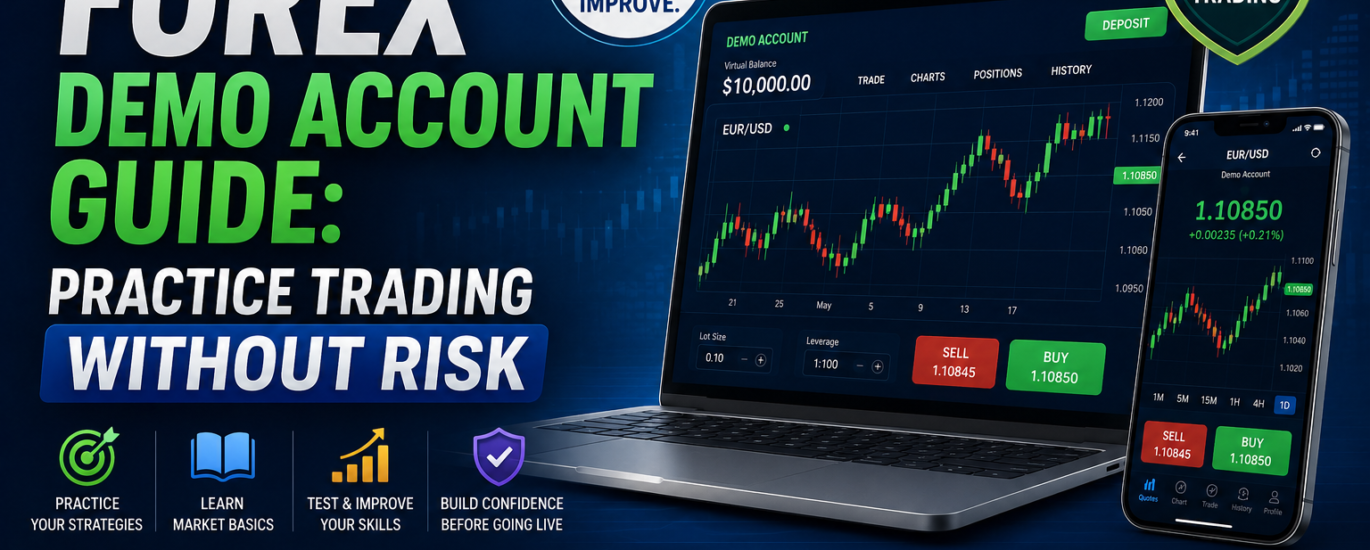
- A Forex Demo Account allows you to trade currency pairs in real-time market conditions using virtual funds, completely eliminating financial risk.
- Demo trading account platforms like MT4 and MT5 provide the exact same technical indicators, charting tools, and price feeds as live accounts.
- Trading on a forex practice account bridges the gap between theoretical knowledge and practical market execution for global traders.
- Transitioning to a live account requires managing psychological shifts, as virtual funds remove the fear and greed associated with real capital.
- Testing custom indicators, automated expert advisors (EAs), and risk management parameters is safest within a forex trading simulator.
- Selecting the right broker for paper trading forex ensures that your simulated execution speeds closely mirror actual live market environments.
Forex Demo Account Guide: Practice Trading Without Risk
The foreign exchange market moves over $7.5 trillion every single day, making it the most liquid financial market on earth. Yet, statistics show that nearly 70% to 80% of retail day traders lose money within their first year. The primary reason for this massive failure rate is not a lack of effort, but a lack of preparation. Jumping straight into the live market with real money before understanding market dynamics is a direct path to financial loss. This is where a Forex Demo Account becomes your most valuable asset, offering a completely simulated environment to hone your skills before risking a single dollar.
Understanding how to leverage a forex practice account is the definitive first step toward sustainable profitability. This comprehensive Forex Demo Account Guide will walk you through everything you need to know about setting up, practicing, and maximizing your simulated trading experience. We will explore how to select the best forex demo account, avoid common pitfalls, and smoothly transition to live trading when the time is right. Whether you are a complete novice or an experienced trader testing a new strategy, mastering the art of simulated trading is non-negotiable.
What is a Forex Demo Account and How Does It Work?
Understanding Virtual Capital and Live Market Feeds
A forex trading demo is a specialized account type offered by online brokerages that replicates a live trading environment. Instead of depositing actual cash, the broker credits the account with a designated amount of virtual funds, often ranging from $10,000 to $100,000. Despite using fake money, the price feeds, charts, and technical indicators you see are tied directly to the real-time movements of the global currency markets. This unique combination allows you to engage in risk-free forex trading while experiencing exactly how currency pairs fluctuate throughout the day.
The Role of Trading Software in Simulation
When you open an online forex demo account, you are typically granted access to industry-standard software like MetaTrader 4 (MT4) or MetaTrader 5 (MT5). The software serves as your command center, allowing you to plot support and resistance lines, apply moving averages, and execute buy or sell orders. The underlying platform handles a virtual trading account identically to a real money account, calculating your floating profits, losses, and margin requirements automatically. This ensures that when you eventually switch to real funds, the technical process of placing trades remains identical.
Who Needs a Forex Practice Account?
While a forex demo account for beginners is essential, simulated trading is not exclusive to newcomers. Professional traders frequently use a forex trading simulator to stress-test complex algorithmic strategies, evaluate new risk-to-reward parameters, or familiarize themselves with a new broker’s platform latency. If you are changing your trading style—such as shifting from swing trading to scalping—doing so first in a simulated environment prevents costly learning mistakes. It acts as a permanent laboratory for your trading business.
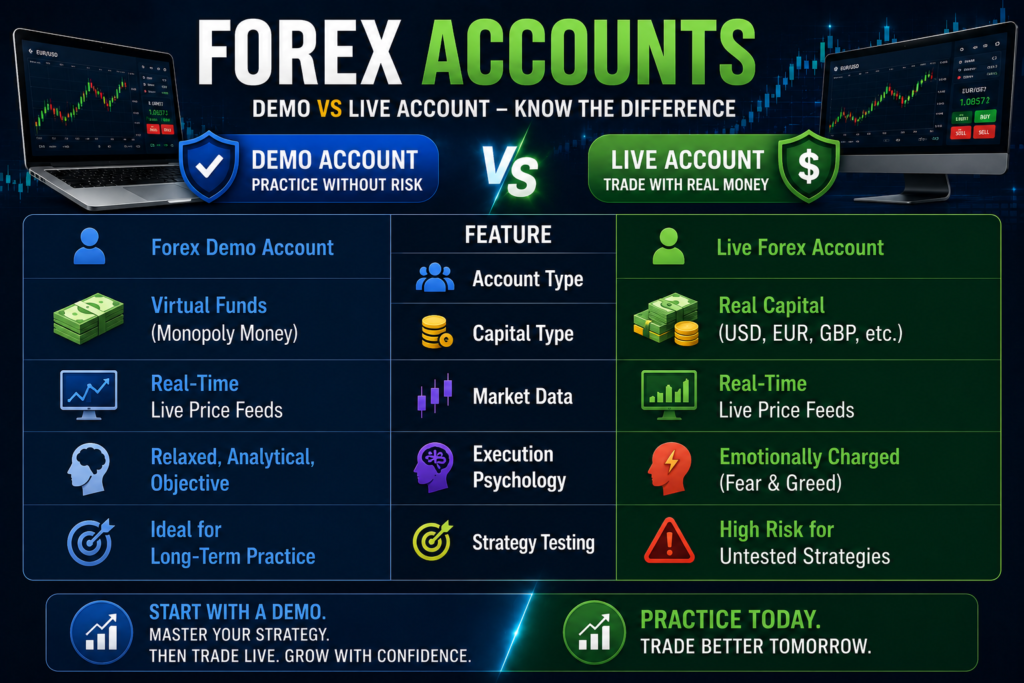
| Feature | Forex Demo Account | Live Forex Account |
| Capital Type | Virtual Funds (Monopoly Money) | Real Capital (USD, EUR, GBP, etc.) |
| Financial Risk | Absolute Zero | High Risk of Capital Loss |
| Market Data | Real-Time Live Price Feeds | Real-Time Live Price Feeds |
| Execution Psychology | Relaxed, Analytical, Objective | Emotionally Charged (Fear & Greed) |
| Strategy Testing | Ideal for Long-Term Practice | High Risk for Untested Strategies |
The Core Benefits of Using a Forex Trading Demo
Mastering the Basics of Platform Navigation
One of the most immediate benefits of a free forex demo account is learning how to operate trading software without the fear of pressing the wrong button. Accidentally entering a market order instead of a limit order, or setting a stop-loss incorrectly, can wipe out a live account instantly. Practicing on a demo trading account lets you make these operational errors safely. You can experiment with different order types, adjust leverage configurations, and customize chart layouts until platform navigation becomes second nature.
Developing and Testing Trading Strategies
To succeed in currency trading, you need an edge—a repeatable set of rules that yields a positive expectancy over time. A forex trading simulator is the ultimate platform for building this edge. You can spend months practicing price action patterns, candlestick formations, or macroeconomic news trading without losing real capital. By documenting your trades in a journal during this phase, you gather statistical data on win rates and drawdown periods, which builds confidence in your methodology.
Gaining Exposure to Market Liquidity and Volatility
Currency markets behave differently depending on the time of day and the specific pairs you trade. For example, the London-New York session overlap features extreme liquidity and rapid price movements, whereas the Asian session is often characterized by tighter consolidation. Using a virtual trading account exposes you to these shifting dynamics. You learn firsthand how economic data releases, like the US Non-Farm Payrolls (NFP), cause sudden spikes in volatility and spread widening across major currency pairs.
Top Trading Platforms: MT4 vs. MT5 Demo Accounts
The Industry Standard: MT4 Demo Account Features
MetaTrader 4 remains the most widely used platform for retail forex traders globally. An MT4 demo account offers an incredibly stable, user-friendly interface optimized specifically for forex trading. It provides access to nine distinct timeframes, a robust package of built-in technical indicators, and support for automated trading via Expert Advisors (EAs). Because it has been the industry standard for nearly two decades, finding educational tutorials, custom scripts, and third-party indicators for MT4 is remarkably easy.
The Modern Successor: MT5 Demo Account Capabilities
For traders looking for advanced features, an MT5 demo account provides enhanced capabilities. MetaTrader 5 is a multi-asset platform, meaning it allows you to simulate trading not just on forex, but also on stocks, commodities, indices, and cryptocurrencies. MT5 boasts 21 timeframes, an integrated economic calendar, an advanced strategy tester for backtesting algorithms, and a native MQL5 programming environment. It also features a Depth of Market (DOM) display, giving you insight into market liquidity at various price levels.
[MetaTrader Ecosystem]
       │
       ├──► MT4 Demo Account ──► Best for Forex Purity & Custom EAs
       │
       └──► MT5 Demo Account ──► Best for Multi-Asset Testing & Advanced Charting
Choosing the Right Platform for Your Style
Your choice between an MT4 or MT5 setup depends entirely on your long-term trading goals. If your sole focus is trading major currency pairs like EUR/USD or GBP/USD using traditional technical indicators, MT4 is highly efficient. However, if you want to incorporate cross-asset analysis or utilize modern backtesting tools, choosing an MT5 platform is optimal. Most best forex brokers with demo account options offer access to both, allowing you to test each system concurrently before making a final commitment.
How to Open a Forex Demo Account: A Step-by-Step Guide
Step 1: Research and Select a Regulated Broker
The first step in learning how to open a forex demo account is selecting a reputable, well-regulated brokerage firm. Even though you are trading with virtual money, you want to choose a broker that you would trust with your real money in the future. Look for entities regulated by tier-one financial authorities such as the FCA (UK), ASIC (Australia), or CySEC (Cyprus). This ensures that the demographic data you provide remains secure and that the price feeds you practice on are entirely accurate.
Step 2: Navigate to the Registration Page
Visit the official website of your chosen broker and click on the “Open Demo Account” or “Practice Account” button. You will be prompted to fill out a brief registration form requiring your name, email address, phone number, and preferred country of residence. Avoid brokers that demand credit card information or extensive financial documentation just to access a free practice environment.
Step 3: Configure Your Virtual Account Parameters
Once your registration is validated, you must configure the parameters of your virtual environment. The platform will ask you to select your preferred trading software (MT4, MT5, or a proprietary web platform), your desired leverage ratio (e.g., 1:30 or 1:100), and your account base currency. Actionable Tip: Always choose an initial virtual balance that matches the amount of real money you intend to deposit later. If you plan to start live trading with $2,000, do not open a demo account with $100,000, as it will distort your understanding of position sizing and risk management.
Step 4: Download the Platform and Log In
After completing the configuration, the broker will display your unique login credentials, including a login ID, master password, and investor password, along with a specific server name. Download the trading platform software to your desktop computer or install the corresponding forex trading practice app on your mobile device. Launch the platform, select the specified demo server, enter your login credentials, and your virtual balance will immediately display in the terminal panel.
How to Practice Forex Trading Effectively
Treat Your Virtual Capital Like Real Money
The single biggest mistake traders make when paper trading forex is treating the virtual funds carelessly. Because there is no real financial consequence, users often execute massive, undisciplined positions, thinking, “It’s just play money.” This approach builds terrible behavioral habits that will quickly ruin a live account. To truly learn forex trading, you must treat every virtual dollar with absolute respect, carefully calculating your position sizing and analyzing market setups just as if your hard-earned savings were on the line.
Establish a Structured Risk Management Plan
A robust trading strategy is nothing without strict risk management parameters. When utilizing your forex practice account, implement a rule where you never risk more than 1% to 2% of your total account balance on any single trade. Use a position size calculator to determine your precise lot sizing based on the distance to your stop-loss order. For instance, if you have a $5,000 balance, your maximum risk per trade should be capped at $50. If a trade hits your stop-loss, analyze why the market moved against you instead of simply opening another random position to recoup the virtual loss.
[Your Account Balance: $5,000]
       │
       ├──► Maximum Risk Per Trade (1%) = $50
       │
       └──► Set Stop-Loss & Position Size to ensure loss never exceeds $50
Keep a Detailed Trading Journal
To transform risk-free forex trading into a structured learning process, you must maintain a trading journal. For every position executed in your simulator, record the date, currency pair, entry price, stop-loss level, take-profit target, and the core rationale behind the trade. Include screenshots of the chart setup at the moment of execution. Reviewing this data at the end of every week allows you to identify behavioral patterns, spot recurring technical errors, and optimize your entry criteria objectively.
Demo vs. Live Trading: The Psychological and Technical Differences
The Illusion of Risk-Free Execution
The primary distinction when analyzing demo vs live trading is the complete absence of emotional pressure in the simulated environment. When you lose $500 of virtual money, your heart rate remains steady and your sleep is unaffected. However, losing $500 of real capital triggers deep psychological responses, including fear, anxiety, anger, and the dangerous urge to “revenge trade.” This emotional disconnect is why many traders perform exceptionally well on a demo platform but struggle significantly when transitioning to a live environment.
Understanding Order Execution and Market Slippage
From a technical standpoint, a demo account vs real account environment can differ slightly regarding order execution speeds. In a simulated environment, your trades are filled instantly at the exact price displayed on your screen because there is no need to find an actual counterparty for the transaction. In live markets, however, large orders or trades placed during high-volatility news events can experience slippage. Slippage occurs when your order is filled at a slightly less favorable price due to market latency and shifts in liquidity pool availability.
Dealing with Broker Spreads and Requotes
In live trading, financial brokers generate revenue by adding a markup to the interbank price, known as the spread. While the best forex brokers with demo account systems replicate these spreads accurately, live conditions can cause spreads to widen dramatically during major economic announcements or market closes. In a simulated account, you rarely experience order requotes—a situation where a broker informs you that the requested price is no longer available. Experiencing these live-market elements requires an adaptation phase that a simulator cannot fully replicate.
Common Mistakes to Avoid When Using a Demo Account
Overstaying Your Welcome in the Simulator
While a forex practice account is highly valuable, staying in the simulated environment for too long can become counterproductive. If you spend two full years demo trading, you risk developing a false sense of security and a lack of urgency. You become comfortable making decisions because there is no penalty for being wrong. Once you have achieved consistent profitability over a continuous three-to-six-month period, you should actively plan your transition to a small, live account to begin managing real-world market emotions.
Utilizing Unrealistic Leverage Ratios
Many modern brokers permit leverage ratios as high as 1:500 on practice accounts. A common mistake among beginners is maximizing this leverage to catch massive, lucky swings on a forex trading demo, turning a $10,000 virtual balance into $50,000 overnight. This is gambling, not trading. In the real world, strict regulatory frameworks in regions like Europe, Australia, and the US cap retail leverage between 1:30 and 1:50 to protect consumers. Keep your demo leverage configured to realistic levels to ensure your training remains practical.
Ignoring the Reality of Trading Costs
Every transaction you execute involves minor fees, such as raw spreads, commissions per lot traded, and overnight swap fees (interest paid or earned for holding positions past the daily market close). Beginners often ignore these subtractions when looking at their net profits inside a virtual trading account. Over a hundred trades, these frictional costs accumulate significantly. Make it a strict habit to analyze your account history tab and calculate exactly how much of your virtual profit was consumed by commissions and swaps.
Step-by-Step Transition Plan: Moving from Demo to Live Trading
Establish a Track Record of Consistency
Before risk-taking with real capital, you must prove your competency to yourself. Establish a clear metric: you must achieve a positive return on investment (ROI) on your forex demo account for a minimum of three consecutive months while maintaining a maximum drawdown of less than 10%. If you experience a major account wipeout during month two, reset your timeline and start the three-month testing block over again. This disciplined filtering mechanism keeps you protected from premature live deployment.
Open a Micro or Cent Account Initially
When you are ready to make the leap, do not immediately deposit a substantial portion of your savings. Instead, open a micro or cent account with your broker. A cent account treats a $10 deposit as 1,000 cents, allowing you to place trades with incredibly tiny financial exposures (e.g., risking 10 to 20 cents per position). This bridges the gap perfectly between practice forex trading and full live trading. It introduces the psychological reality of real financial wins and losses without exposing you to ruinous stress.
[Demo Account] ──► Virtual Funds, Zero Psychological Weight
       │
       ▼
[Cent/Micro Account] ──► Real Funds, Cent-Scale Exposure (Low Risk Bridge)
       │
       ▼
[Standard Live Account] ──► Real Funds, Fully Scaled Professional Risk
Gradually Scale Your Account Size
Once you prove that your emotional control and execution discipline remain intact while managing a micro account, you can slowly scale your capital base. Increase your account deposit incrementally every quarter, provided your performance metrics remain positive. Remember, the core mechanics of technical analysis, price action tracking, and order placement remain identical across all account tiers. Your only challenge during this scaling phase is mastering your internal psychological response to larger numbers.
Advanced Tips for Maximizing Your Forex Demo Account Experience
Test Alternative System Environments Concurrent with Desktop
Modern market realities require constant monitoring, making it beneficial to install a reliable forex trading practice app alongside your primary desktop workstation setup. Use the mobile application to track open simulated positions, modify stop-loss levels while away from your desk, and observe how alerts trigger on your smartphone. This builds operational comfort with mobile execution, ensuring that if you ever experience a power failure or internet drop at home while live trading, you can pivot to your mobile device seamlessly.
Replicate Worst-Case Scenarios intentionally
Use the safety of a forex trading simulator to deliberately experience stressful events. What happens if you leave a trade open over the weekend and the market gaps down 100 pips against you? What happens if you forget to set a stop-loss during a high-impact interest rate decision? By purposely exposing a practice account to these extreme tail-risk events, you learn exactly how the broker’s margin call and stop-out mechanisms function, removing scary operational unknowns before they happen in reality.
Focus Intently on One Currency Pair Initially
Avoid the temptation to trade thirty different currency cross-pairs simultaneously. When you start forex trading with demo account parameters, pick a single highly liquid major pair, such as EUR/USD or GBP/USD. Spend weeks observing its specific personality, its average daily range (ADR), how it responds to key economic releases, and how it behaves around psychological round numbers. Becoming an expert in the nuances of one pair is infinitely more profitable than being distracted by dozens of instruments simultaneously.
Elevate Your Digital Strategy with fxorbits
Building a disciplined approach to the financial markets requires precision, technical optimization, and reliable software performance. At fxorbits, we understand the critical role that seamless digital platforms play in business growth. Our specialist team has successfully helped more than 80 businesses globally scale their online operations through expert WordPress web design, custom development, and highly targeted SEO strategies. Whether you are building an advanced financial platform or looking to attract targeted global audiences, we build high-performance web ecosystems tailored to your exact industry goals.
Frequently Asked Questions (FAQs)
What is a Forex Demo Account?
A Forex Demo Account is a free practice platform provided by currency brokers that allows users to simulate live trading using virtual funds. It utilizes real-time market data feeds, enabling beginners to learn platform navigation and test strategies without facing financial risk.
Are prices on a forex demo account completely accurate?
Yes, reputable brokers provide identical real-time price feeds for both their demo and live accounts. However, simulated accounts execute orders instantaneously without encountering real-world market variables like liquidity shortages, order slippage, or broker requotes during extreme volatility phases.
How long should I practice on a demo trading account?
Most experts recommend staying on a demo platform for three to six consecutive months, or until you achieve steady profitability. The transition should occur once you fully understand platform mechanics, risk management, and your chosen technical strategy.
Can you make real money using a free forex demo account?
No, you cannot withdraw profits generated from a demo account because the capital utilized is entirely virtual. The sole purpose of a practice environment is to acquire skills and test methodologies without risking capital before funding a live account.
What is the difference between an MT4 and MT5 demo account?
An MT4 demo account focuses cleanly on forex trading with a straightforward, time-tested framework. An MT5 demo account provides an upgraded, multi-asset infrastructure, offering more technical timeframes, an economic calendar, and advanced algorithmic backtesting capacities.
Is paper trading forex completely free?
Yes, top tier regulated brokerages offer online demo and paper trading accounts entirely free of charge. They utilize these practice setups as an educational pipeline to help users build competence before opening a real-money trading account.
Why do traders fail when transitioning to live accounts?
Traders often struggle during transitions due to intense psychological shifts. A simulated environment eliminates the emotional strain of losing real money. When actual capital is introduced, fear and greed frequently lead to undisciplined decision-making.
Conclusion
A Forex Demo Account is an invaluable tool for anyone looking to navigate the complex world of currency trading safely. It provides an essential foundation for learning platform operations, refining technical strategies, and experiencing live market volatility without financial risk. However, the true value of a forex practice account depends on your personal discipline. By treating virtual funds with the same seriousness as real capital, setting conservative leverage limits, and maintaining a detailed journal, you build the correct habits required for long-term profitability.
Remember that while a simulator builds operational competence, your ultimate success requires mastering the psychological pressures introduced by live capital. Use the step-by-step transition process outlined in this guide to scale up gradually from a demo account to a micro account, keeping your risk strictly managed at every stage.
