Key Takeaways
- Regulatory Framework: Exness holds top-tier international regulatory licenses (CySEC, FCA), whereas Octa operates primarily through offshore entities (MISA) for international clients.
- Trading Fee Structures: Exness features zero-spread professional accounts with fixed commissions, while Octa focuses on commission-free, spread-only structures.
- Local Banking Access: Both brokers provide localized deposit and withdrawal mechanisms tailored for Indian banking systems, though processing windows vary.
- Leverage Scalability: Exness provides higher maximum leverage scales (up to unlimited) compared to Octa’s maximum 1:1000 threshold.
- Platform Toolkits: Octa offers an integrated copy-trading application, whereas Exness emphasizes comprehensive TradingView charting and analytical trade tickets.
- FEMA Compliance Reminder: Retail spot forex via offshore brokers faces strict RBI boundaries; residents must understand legal parameters before committing local capital.
Choosing a reliable infrastructure partner is one of the most critical decisions an active retail currency trader has to make. The global foreign exchange market operates continuously, and even minor differences in order execution speeds, spread markups, or payment processing turnarounds can significantly impact net trading returns over time. For individuals evaluating the competitive landscape of forex brokers in India, two brands consistently lead the conversation: Exness and Octa.
The core challenge isn’t a lack of options, but rather identifying which platform’s architecture matches your specific trading style, capital size, and risk tolerances. Both brokerages have invested heavily in localized systems, creating tailored entry portals featuring local banking support, dedicated digital accounts, and multi-language client support desks.
This comprehensive Exness vs Octa analysis examines the specific details behind their regulatory setups, fee metrics, leverage policies, and platform features. Whether you are a retail scalper needing low-latency execution or a structural swing trader seeking long-term swap-free positions, this breakdown will clarify which platform serves as the best forex broker for Indian traders in 2026.
Regulatory Assessment and Trust Baseline
Global Licensing Overview: Exness vs Octa Regulation
When evaluating any brokerage infrastructure, security of capital must be your primary filter. A platform’s regulatory framework reveals its structural reliability and client protection standards. In the arena of Exness vs Octa regulation, clear differences exist in how each firm structures its global operations.
Exness operates under strict oversight from multiple high-tier regulatory bodies worldwide. Its regional divisions hold operational licenses from highly strict watchdogs, including the Financial Conduct Authority (FCA) in the United Kingdom and the Cyprus Securities and Exchange Commission (CySEC). These entities enforce rigorous accounting rules, mandatory capital reserves, and frequent operational audits.
[Exness Infrastructure] ──> Oversight by Tier-1 Regulators (FCA, CySEC) ──> High Trust Architecture
[Octa Infrastructure]   ──> Offshore Registry Frameworks (MISA, FSC)   ──> Flexible Operational Rules
Octa (formerly known widely as OctaFX) takes a more streamlined operational approach. While its European division maintains compliance with CySEC guidelines, its international client accounts—including those for retail traders across South Asia—are generally managed by corporate entities registered within offshore economic zones like the Mwali International Services Authority (MISA) in the Comoros. Offshore registration allows the broker to offer flexible account terms, but it does not provide the same level of consumer protection as Tier-1 frameworks.
Client Resource Protection Systems
Both platforms utilize segregated bank accounts to protect retail client capital. This structural division ensures that your trading balances are kept entirely separate from the broker’s operational funds, preventing client capital from being used for corporate expenses.
Additionally, both brokers provide automated negative balance protection as a core standard across their accounts. This mechanism acts as a critical safety valve during black swan events or massive weekend price gaps, automatically closing out losing positions before your account balance can fall below zero.
Navigating the Compliance Rules for Forex Brokers in India
It is vital for local market participants to understand the regulatory context surrounding international forex brokers in India. The Reserve Bank of India (RBI) and the Securities and Exchange Board of India (SEBI) maintain a strict regulatory stance regarding retail margin trading through offshore entities.
Actionable Tip: Under the Foreign Exchange Management Act (FEMA), Indian residents are legally permitted to trade currency derivatives on domestic platforms like the NSE and BSE, focusing on pairs matched with the Indian Rupee (INR). If you choose to explore global spot markets via international broker networks like Exness for Indian traders or Octa for Indian traders, you assume full personal responsibility for complying with domestic banking, remittance, and tax reporting regulations.
Trading Costs, Spreads, and Fee Frameworks
Detailed Pricing Comparison: Exness vs Octa Spreads
Your ongoing trading costs have a direct, measurable impact on your long-term profit margins, making a careful review of Exness vs Octa spreads essential. Both brokerages offer variable, market-driven spreads that adjust dynamically based on real-time liquidity conditions.
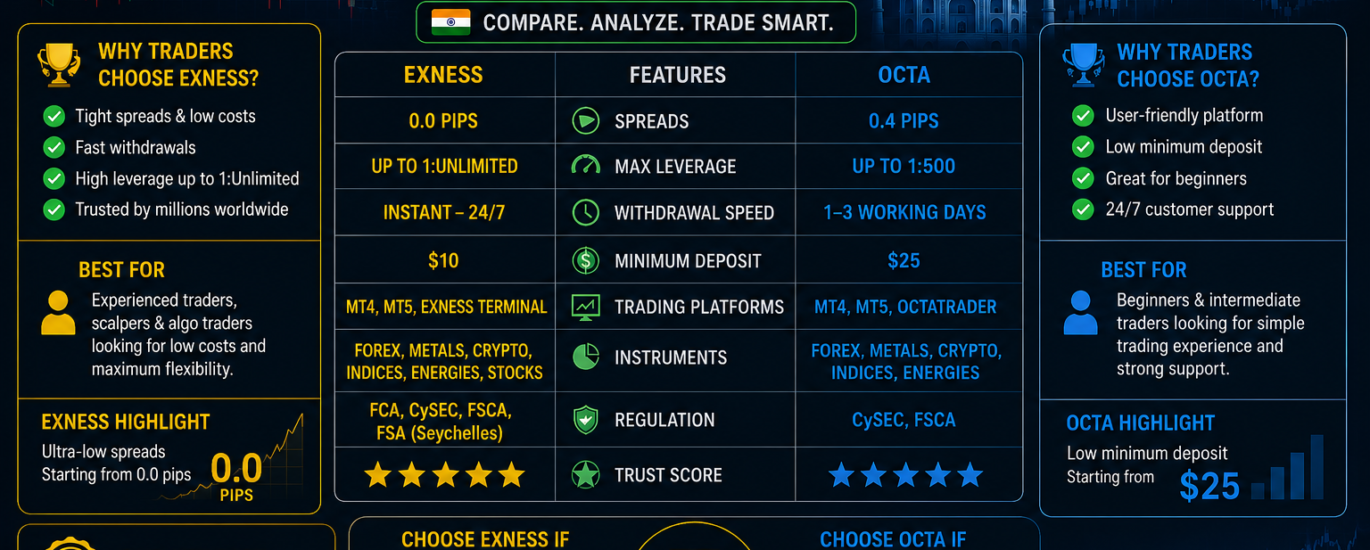
On standard, commission-free retail accounts, Exness typically maintains an average spread ranging between 0.9 and 1.2 pips on major pairs like EUR/USD during liquid trading sessions. Octa provides highly competitive pricing on its standard accounts, often matching or slightly beating these baseline spreads, with averages frequently sitting between 0.6 and 0.9 pips on major pairs.
| Broker & Account Variant | Average EUR/USD Spread | Commission Costs | Target User Strategy |
| Exness Standard | 0.9 – 1.2 Pips | Zero Commission | Retail Beginners |
| Exness Raw Spread | 0.0 – 0.2 Pips | $3.50 Per Side ($7 Round) | High-Volume Scalpers |
| Exness Zero | 0.0 Pips Fixed | Varies from $3.50 Per Side | Algorithmic Traders |
| Octa Standard | 0.6 – 0.9 Pips | Zero Commission | Day Traders / Swing Traders |
Commission Models and Hidden Processing Costs
For active day traders, structural differences in Exness vs Octa fees become highly visible when looking at professional account tiers. Exness offers specialized professional tiers, such as the Raw Spread and Zero accounts, which lower institutional spreads down to 0.0 pips in exchange for a flat commission fee of $3.50 per side ($7.00 per round lot).
[Exness Raw Account] ──> Interbank Market Spread (0.0 Pips) + Flat Commission ──> Highly Predictable Cost Model
[Octa Standard Account] ──> Combined Markup Spread (0.6 - 0.9 Pips) + No Commission ──> Simplified Execution
Octa focuses on a more simplified, spread-only commission model for its international retail accounts. By embedding all execution costs directly within the floating spread, Octa removes the need to calculate separate per-lot commissions, making it easier for new traders to manage their metrics.
Swap Mechanics and Non-Trading Fees
Overnight financing costs can slowly erode your profits if you hold positions across multiple days. Fortunately, both platforms offer excellent swap-free accounts tailored for Indian clients, ensuring that Sharia-compliant and long-term swing positions don’t face daily rollover fees.
Real-World Example: A swing trader holding an open GBP/USD position for three weeks would normally accumulate significant interest charges on standard retail platforms. Using the swap-free frameworks provided by these brokers allows you to maintain long-term positions without worrying about daily rollover fees cutting into your returns. Additionally, neither broker charges inactivity fees, meaning your balances won’t face penalty deductions during extended breaks from active trading.
Account Structures and Leverage Parameters
Reviewing Options: Exness vs Octa Account Types
Having access to flexible account configurations allows you to select an environment that perfectly matches your underlying capital size and strategy. The Exness vs Octa account types ecosystem highlights different operational approaches.
Exness provides a highly diverse set of account choices designed to scale alongside your development:
- Standard Cent: An entry-level tier using micro-lots, allowing beginners to practice with real market conditions using minimal capital.
- Standard Account: The core retail account option, requiring low initial balances and offering accessible market entry.
- Pro Tier: A specialized account offering instant order routing and ultra-low raw spread markups.
Octa focuses heavily on simplicity, offering a streamlined, all-in-one account structure. Instead of managing multiple professional tiers, Octa routes its users through standardized accounts optimized for their preferred software interface (such as MT4, MT5, or their proprietary OctaTrader engine).
Risk Controls within Exness vs Octa Leverage Limits
Leverage can help expand your market exposure, but using it excessively can greatly accelerate capital losses if the market moves against you. Reviewing Exness vs Octa leverage policies shows distinct risk management styles.
[Exness Accounts] ──> Unlimited Leverage Tiers Available ──> Extreme Risk Control Needed
[Octa Accounts]   ──> Maximum Leverage Capped at 1:1000  ──> Standard Structural Bounds
Exness provides highly flexible margin settings, offering unlimited leverage options on specific retail accounts when trading with low equity levels. While this offers maximum flexibility for experienced traders, using high leverage levels without strict discipline can quickly wipe out an account. Octa maintains a fixed upper limit of 1:1000 for standard currency instruments, providing substantial margin flexibility while keeping structural boundaries in place.
Minimum Funding Requirements
Both brokers feature low entry barriers, making them highly accessible for retail participants. Exness allows standard accounts to be opened with nominal initial amounts starting around $10 to $100 depending on the payment channel, while its professional tiers require a $1,000 threshold. Octa sets a clear, accessible entry line across its standard portals, typically requiring a low minimum deposit of just $25.
Software Systems and Mobile Infrastructure
Platform Comparison: Exness vs Octa MT4 MT5 Support
Having access to a fast, stable trading interface is essential for executing strategies cleanly during fast-moving market sessions. Comparing Exness vs Octa MT4 MT5 compatibility shows that both brokerages integrate smoothly with MetaQuotes’ industry-standard software.
                  ┌── MetaTrader 4 / MetaTrader 5 (Industry Standard)
Exness & Octa ────┼── Proprietary Web Terminal Engines
                  └── Native iOS & Android Mobile Apps
Both platforms support MetaTrader 4 and MetaTrader 5 across desktop environments, web browsers, and mobile devices. This extensive support allows you to run customized Expert Advisors (EAs), implement automated technical indicators, and build algorithmic backtesting routines without compatibility issues.
Testing the Proprietary Platforms
Beyond standard MetaTrader support, both firms have invested heavily in building modern, proprietary web platforms. The Exness Terminal features deep integration with native TradingView charting engines, providing active technical analysts with access to over a hundred indicators, versatile drawing tools, and clean, modular trade tickets.
Octa’s proprietary ecosystem centers around the OctaTrader engine. This custom web dashboard focuses on ease of use, integrating market insights, an economic calendar, and automated technical analysis feeds directly into your workspace.
Mobile Usability: Exness vs Octa Trading App Performance
For modern traders who need to monitor positions on the go, a broker’s mobile application performance is just as important as their desktop setup. Evaluating the Exness vs Octa trading app experience reveals two distinct styles.
[Exness App Ecosystem] ──> TradingView Charts + Advanced On-Ticket Risk Calculators
[Octa App Ecosystem]   ──> Built-In CopyTrading Portals + Native Analysis Timelines
The Exness Trade app stands out for its execution polish, featuring built-in risk calculators that allow you to size positions based on a exact dollar value or account equity percentage before placing a trade. The Octa Trading app focuses on creating an all-in-one experience, directly embedding their popular copy-trading service into the mobile interface to let users discover, track, and mirror seasoned investors seamlessly.
Payment Operations: Funding and Capital Controls
Local Currency Integrations: Exness vs Octa Deposit and Withdrawal Systems
For local retail traders, payment logistics can often be a major point of friction. Evaluating Exness vs Octa deposit and withdrawal systems highlights why both brands have grown so popular across the country. They have largely bypassed slow international wire transfers by integrating local payment channels directly into their user dashboards.
Both platforms allow you to fund your account using local Indian options, including:
- Unified Payments Interface (UPI) transfers
- IMPS and local net banking transfers
- Popular digital wallets like Neteller and Skrill
These local options allow you to deposit and withdraw funds using Indian Rupees (INR), helping you avoid expensive international conversion markups.
[Traders' Capital] ──> UPI / Net Banking / IMPS Portal ──> Instant Conversion-Free Allocation
Settlement Turnarounds and Execution Speeds
Exness stands out in the industry for its highly automated payment processing engine, which allows for instant withdrawal settlements across various electronic payment channels. This means that once a withdrawal request is submitted, the funds are often processed and moved into your account within minutes, even during holiday periods or weekends.
Octa handles financial requests using a combination of automated steps and dedicated manual reviews. While deposits generally clear instantly, withdrawal requests are manually verified by their processing team, typically settling within a few hours to a business day.
Actionable Tip: To avoid unexpected delays during market volatility, always ensure your account verification paperwork (including Proof of Identity and Proof of Address documents) is fully approved before funding your account.
Client Support and Educational Infrastructure
Communication Channels: Exness vs Octa Customer Support Availability
When technical challenges or payment questions arise, having access to a fast, reliable support desk is invaluable. Looking at the Exness vs Octa customer support landscape shows that both brokerages offer comprehensive help options.
Exness operates a 24/7 customer support infrastructure accessible through live web chat, email tickets, and international phone lines. Their support teams are trained to resolve technical inquiries quickly, and they provide dedicated support channels in multiple languages, including Hindi, to assist local traders effectively.
[Active Trader Query] ──> 24/7 Digital Helpdesks (Live Web Chat / Multi-Language Support) ──> Rapid Resolution
Octa also provides 24/7 customer support across its main digital platforms. Their support channels focus heavily on live web chat and messaging app integrations, allowing users to connect with support agents directly through their phones or user dashboards. Octa has also localized its support experience by providing native Hindi translation options throughout its main site and documentation.
Learning Tools and Educational Assets
Octa stands out for its extensive educational resources, making it a highly attractive option for newer traders. The platform regularly produces detailed trading guides, webinars, and live market breakdown videos designed to help beginners build foundational skills.
Exness focuses its educational resources on providing advanced market data and analysis tools. Rather than focusing purely on beginner tutorials, Exness provides detailed macroeconomic reports, trading calculators, and integrated technical analysis streams via Trading Central to help experienced traders refine their daily execution strategies.
Final Synthesis: Weighing the Strengths and Weaknesses
Direct Comparison: Exness vs Octa Pros and Cons
To help you see how these platforms compare at a glance, here is a concise breakdown of the core strengths and limitations of both Exness vs Octa features.
Exness Strengths:
- Highly automated, near-instant withdrawal processing across electronic methods.
- Tight institutional spreads starting at 0.0 pips on premium account types.
- Strict regulatory compliance backed by high-tier international licenses (FCA, CySEC).
- Deep integration with TradingView charting software.
Exness Limitations:
- The professional accounts require a higher initial deposit barrier of $1,000.
- The high leverage settings require strict personal discipline to avoid outsized losses.
Octa Strengths:
- Affordable and accessible account options with a low minimum deposit of $25.
- Highly integrated, user-friendly mobile copy-trading system.
- Simplified, commission-free fee structure across all primary accounts.
- Comprehensive educational resources and video tutorials for beginners.
Octa Limitations:
- International accounts operate under offshore corporate registrations (MISA).
- Fewer professional account variations for advanced algorithmic strategies.
Head-to-Head Feature Scorecard
Review this direct scorecard evaluating key performance metrics for both platforms:
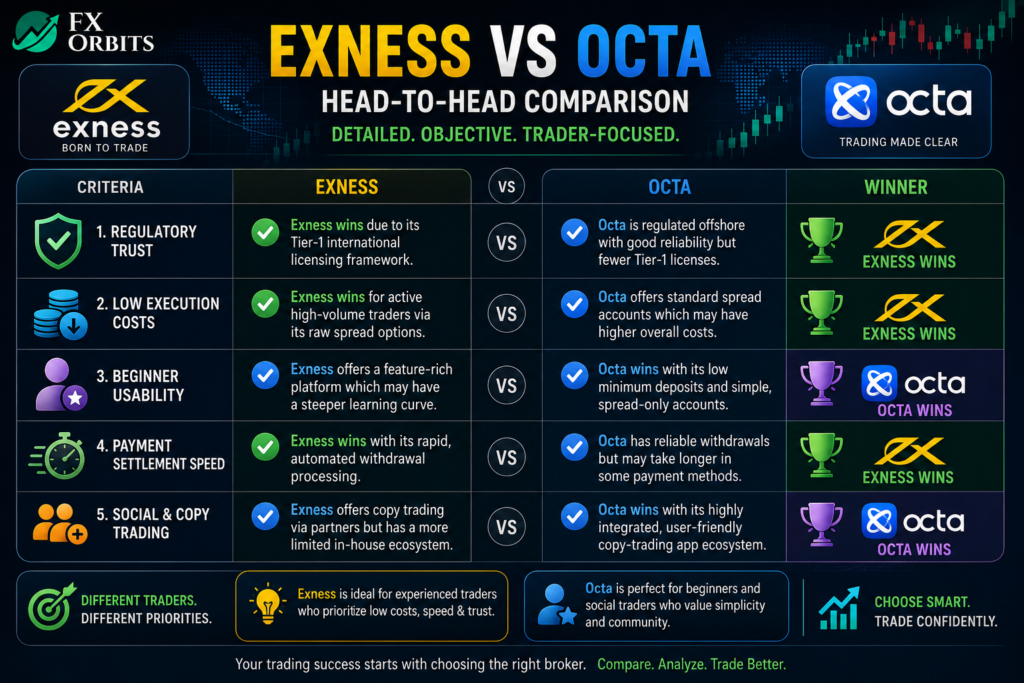
- Regulatory Trust: Exness wins due to its Tier-1 international licensing framework.
- Low Execution Costs: Exness wins for active high-volume traders via its raw spread options.
- Beginner Usability: Octa wins with its low minimum deposits and simple, spread-only accounts.
- Payment Settlement Speed: Exness wins with its rapid, automated withdrawal processing.
- Social and Copy Trading: Octa wins with its highly integrated, user-friendly copy-trading app ecosystem.
Optimizing Your Digital Platform for Maximum Performance
Building a successful trading career requires a fast, stable, and highly reliable technical setup. The same principle applies to growing your business online. If your website suffers from slow loading times, confusing navigation, or poor search engine visibility, you are likely missing out on valuable customer conversions every single day.
Our team at fxorbits specializes in building fast, secure WordPress websites and data-driven SEO strategies that help businesses stand out in competitive digital spaces. We have helped over 80 businesses optimize their search rankings, stream-line their digital workflows, and build high-converting online platforms.
Whether you need a complete custom website redesign or a targeted SEO strategy to boost your organic search rankings, we have the expertise to help your business grow. Connect with us at fxorbits today to find out how we can help elevate your digital presence.
Frequently Asked Questions
Which broker is better for day trading, Exness or Octa?
For active day traders and scalpers, Exness is generally the stronger option due to its specialized Raw Spread and Zero accounts. These professional tiers offer tight spreads down to 0.0 pips alongside low, predictable round-turn commissions, helping high-volume traders keep execution costs minimal.
Do Exness and Octa support local deposit methods in India?
Yes, both brokers offer excellent support for local banking networks, allowing Indian traders to fund and withdraw from their accounts using UPI, IMPS, and local net banking transfers. This integration helps traders avoid the high conversion fees associated with international wire transfers.
What is the minimum deposit requirement for Exness vs Octa?
Octa features an accessible entry level with a low minimum deposit requirement of just $25 across its standard accounts. Exness allows standard accounts to be opened with nominal amounts starting around $10 to $100, while its professional tiers require a $1,000 initial balance.
Are there any overnight swap charges on these platforms?
Both brokerages provide excellent swap-free account choices automatically optimized for Indian clients. This allows you to hold long-term swing trading positions across multiple weeks without incurring daily interest or rollover fees.
Can I use automated trading robots on Exness and Octa?
Yes, both platforms offer full compatibility with MetaTrader 4 and MetaTrader 5. This standard integration allows you to run custom Expert Advisors (EAs), deploy automated trading scripts, and utilize complex backtesting tools without structural issues.
How long do withdrawals take on Exness compared to Octa?
Exness uses an automated payment engine that processes electronic withdrawals almost instantly, often moving funds within minutes. Octa uses manual verification steps to ensure transaction security, typically processing and settling withdrawal requests within a few hours to one business day.
Which broker is safer for retail capital?
Exness holds a stronger regulatory profile because its regional divisions are licensed by strict, high-tier global authorities like the FCA and CySEC. Octa handles its international retail client base primarily through offshore registrations, which provide fewer formal consumer protections.
Conclusion
Deciding which forex broker is better ultimately depends on your personal trading style, capital size, and experience level. Exness vs Octa stands out as an exceptional choice for high-volume day traders, professional scalpers, and algorithmic users who require ultra-low raw spreads, high leverage flexibility, and rapid, automated withdrawal processing. On the other hand, Octa provides a highly accessible, user-friendly entry point perfectly suited for beginners, thanks to its low minimum deposit requirements, simple commission-free accounts, and built-in mobile copy-trading features.
Always prioritize protecting your capital by using strict risk management guidelines, choosing appropriate leverage scales, and practicing your strategies on a demo account before risking live capital. Ensuring your trading infrastructure aligns with your long-term goals will help you build a more consistent, disciplined approach to the markets.