

Key Takeaways
- Conditional Legality: Forex trading is legal in India only when conducted through SEBI-registered brokers on recognized domestic stock exchanges.
- Prohibited Instruments: Retail spot forex trading, Contracts for Difference (CFDs), and high-leverage margin accounts provided by offshore platforms are strictly illegal under Indian law.
- Allowed Asset Classes: Indian traders are only permitted to trade exchange-traded currency derivatives (futures and options) via NSE, BSE, and MSE.
- Strict Currency Restrictions: Legal trading is limited to four INR-paired currencies (USD/INR, EUR/INR, GBP/INR, JPY/INR) and three cross-currency pairs (EUR/USD, GBP/USD, USD/JPY).
- The LRS Prohibition: Funding offshore retail forex accounts using the Liberalised Remittance Scheme (LRS) is explicit non-compliance and violates FEMA guidelines.
- Severe Penalties: Violators face heavy financial penalties up to three times the transacted amount under Section 13 of FEMA, along with potential bank account freezes.
The global foreign exchange market moves over $7.5 trillion every single day, making it the largest and most liquid financial sector on earth. For retail day traders in India, the promise of capturing small movements in major currency pairs like the Euro or US Dollar sounds incredibly lucrative. However, thousands of unsuspecting Indian traders open accounts on slick international smartphone applications every month, completely unaware that they might be breaking federal financial laws.
The legal boundaries surrounding currency speculation in India are famously strict, often leaving market participants confused about what they can and cannot do. If you have ever wondered, is forex trading legal in India, the short answer is yes—but only under a very specific, tightly regulated framework designed by the government. Stepping outside this legal fence carries severe civil and financial consequences.
To help you navigate this complex financial landscape safely, this guide breaks down the precise rules enforced by the Reserve Bank of India (RBI) and the Securities and Exchange Board of India (SEBI). We will explore the permitted asset classes, break down the structural framework of the Foreign Exchange Management Act (FEMA), expose the traps of offshore brokers, and show you exactly how to trade currencies without breaking the law.
The Legal Landscape of Currency Trading in India
To truly understand how the Indian state views currency speculation, one must unpack the overarching balance between individual trading freedom and macro-economic stability. The legal environment is engineered to shield the domestic economy from excessive volatility.
The Core Question: Is Forex Trading Legal in India?
Yes, currency trading is perfectly legal within the boundaries of the Indian sub-continent, provided you meet three baseline criteria: you must trade through a SEBI-registered domestic broker, execute your trades on a recognized Indian stock exchange, and only trade approved currency derivatives. Traditional “spot forex” trading—where you buy and sell physical currencies or speculate via international margin accounts with immense leverage—is illegal for Indian resident individuals. The state views unbacked margin trading as a form of capital flight that exposes retail investors to predatory foreign entities.
Overlapping Authority: How RBI and SEBI Govern the Market
The Indian currency market is uniquely dual-regulated:
- The Reserve Bank of India (RBI): Acts as the ultimate custodian of India’s foreign exchange reserves. The RBI determines macroeconomic policy, monitors capital inflows and outflows, and dictates which currency instruments are fundamentally permissible.
- The Securities and Exchange Board of India (SEBI): Acts as the micro-level market regulator. SEBI oversees the operational conduct of domestic stock exchanges (like the NSE and BSE), enforces clearing house rules, issues licenses to individual brokerages, and sets local margin and leverage limits to protect everyday retail clients.
The Shift from FERA to FEMA 1999
Historically, India managed its foreign capital through the draconian Foreign Exchange Regulation Act (FERA) of 1973. Under FERA, any unauthorized foreign exchange transaction was treated as a severe criminal offense, carrying automatic presumptions of guilt and mandatory jail time. Recognizing that an expanding, globalized Indian economy required a more modern framework, the government replaced FERA with the Foreign Exchange Management Act (FEMA) of 1999. FEMA shifted the legislative approach from criminal prohibition to civil regulation. While violations under FEMA are civil infractions punished primarily through catastrophic monetary fines rather than immediate arrest, persistent non-compliance or outright money laundering still triggers severe enforcement prosecution.
Understanding RBI Forex Trading Rules and Guidelines
The central bank’s primary mission in restricting forex trading is to protect the stability of the Indian Rupee (INR) and maintain an orderly balance of payments. Unchecked outbound speculation could drain India’s foreign reserves during times of global economic distress.
The Liberalised Remittance Scheme (LRS) Loophole Clarified
A widespread point of confusion among retail traders is the Liberalised Remittance Scheme (LRS). Under the modern LRS framework, the RBI permits resident Indian individuals to legally remit up to USD 250,000 per financial year abroad for specific, approved purposes like overseas education, medical treatment, real estate purchases, or investing in international equities.
However, the RBI has explicitly closed the door on using LRS funds for speculative trading. It is illegal to use the LRS quota to send money overseas to fund margin accounts, settle margin calls, or deposit capital into international forex brokerages. The LRS is strictly an investment and utility pathway, not a mechanism for global day trading or leverage-based speculation.
Forbidden Zones: Margins, Leverage, and Overseas Transfers
The RBI explicitly prohibits residents from transferring funds to any overseas counterparty for the sake of forex trading. This includes funding accounts via international credit cards, debit cards, global online payment processors, or decentralized cryptocurrencies. Furthermore, because offshore retail brokers operate on a decentralized Over-The-Counter (OTC) basis with no centralized clearing house inside India, the RBI cannot audit or protect those transactions, making any capital sent to them a structural violation of Indian exchange control laws.
The Foreign Exchange Management (Authorised Persons) Regulations 2026 Update
The regulatory ecosystem has grown even stricter under the Foreign Exchange Management (Authorised Persons) Regulations, 2026. This updated framework consolidates fragmented historic guidelines into a highly centralized compliance architecture. Under the 2026 rules, the RBI has drastically scaled up the net worth requirements for Authorized Dealers (AD Category-II entities now require a minimum net worth of ₹10 Crore) to weed out unstable middlemen.
More importantly, the 2026 framework has completely shut down fresh franchisee models for money changing, replacing them with a strict principal-agent “Forex Correspondent” (FxC) model where every transaction must be reflected on the core books of a primary licensed entity. This ensures complete traceability of all foreign exchange movements, giving authorities real-time visibility into unauthorized capital flows.
Actionable Tip: If an online platform claims you can fund your wallet using local Indian payment apps like UPI or IMPS to trade global currency pairs like USD/CAD or AUD/CHF, stop immediately. These platforms route funds through localized shell companies to mask illegal international hawala transfers.
SEBI Forex Trading Regulations and Permitted Instruments
While the RBI draws the macro boundaries of capital flow, SEBI dictates the exact micro-mechanics of how a compliant individual can trade currencies within India.
The Nature of Exchange-Traded Derivatives vs. Spot Forex
The fundamental legal difference boils down to where and how the trade is executed. International spot forex involves buying one currency and selling another simultaneously in an unregulated global OTC market, often with massive leverage up to 1:500 or 1:1000.
In contrast, legal trading in India is strictly restricted to Exchange-Traded Derivatives (ETDs), specifically Futures and Options (F&O). These contracts do not involve the physical delivery of foreign banknotes; instead, they are standardized financial contracts traded on local, transparent exchanges and are completely cash-settled in Indian Rupees (INR).
| Feature | Legal Indian Currency Trading | Illegal Offshore Spot Forex |
| Market Structure | Centrally cleared Exchange-Traded Derivatives (ETD) | Over-The-Counter (OTC) Decentralized Network |
| Allowed Venues | NSE, BSE, MSE | International Apps / Web Brokers |
| Settlement Currency | Strictly Indian Rupee (INR Cash-Settled) | Foreign Currencies (USD, EUR, Crypto) |
| Leverage Available | Low, tightly controlled by SEBI (~1:25 to 1:40) | High, uncontrolled (1:100 to 1:1000) |
| Regulatory Protection | Full SEBI Investor Grievance Redressal | No legal recourse inside India if funds vanish |
Allowed Currency Pairs: INR and Cross-Currency Frameworks
SEBI permits retail investors to trade a precise, limited menu of currency pairs. You cannot trade exotic currency pairs, commodity-tied currencies, or crypto cross-rates. The allowed pairs are broken into two primary categories:
- INR-Paired Currency Derivatives (Four Permitted Pairs):
- USD/INR: US Dollar vs. Indian Rupee (the most liquid, heavily traded contract).
- EUR/INR: Euro vs. Indian Rupee.
- GBP/INR: British Pound vs. Indian Rupee.
- JPY/INR: Japanese Yen vs. Indian Rupee (quoted per 100 Yen units).
- Cross-Currency Derivatives (Three Permitted Pairs):
- EUR/USD: Euro vs. US Dollar.
- GBP/USD: British Pound vs. US Dollar.
- USD/JPY: US Dollar vs. Japanese Yen.
Even when trading cross-currency pairs like EUR/USD, the underlying contract must be traded on an authorized Indian exchange and settled entirely in INR based on official RBI reference rates.
Strict Leverage and Position Limits on Indian Exchanges
To protect the retail trading public from destroying their capital overnight, SEBI enforces strict margin and position restrictions. Instead of the extreme leverage offered by offshore entities, SEBI-regulated currency derivatives require an initial margin (typically around 3% to 5% of the total contract value) alongside an extreme loss margin (usually 1%). This equates to a safe, capped leverage ratio of roughly 1:20 to 1:30. Furthermore, SEBI mandates open-position limits across exchanges—capping retail clients at 6% of the total open interest or USD 10 million (whichever is higher) to prevent rogue traders from manipulating currency values.
Identifying Unauthorised Offshore Trading Platforms and Red Flags
The rise of targeted social media advertising has made it incredibly easy for unauthorized offshore entities to target young Indian investors with promises of fast wealth. Identifying these platforms is your first line of legal defense.
The RBI Alert List: What It Is and How to Use It
The RBI maintains and continuously updates an official compliance directory known as the RBI Alert List. This public register explicitly names corporate entities, websites, mobile applications, and electronic trading platforms (ETPs) that are completely unauthorized to deal in foreign exchange or offer currency trading services under FEMA. The list covers prominent offshore platforms that actively solicit Indian users through aggressive digital marketing campaigns. Before you deposit a single rupee with any platform, it is your responsibility to cross-verify the entity against the live RBI Alert List on the central bank’s official portal.
Common Red Flags of Illegal Offshore Forex Brokers
Unlicensed offshore platforms share distinct operational characteristics designed to bypass domestic financial surveillance. Watch out for these operational red flags:
- Promises of Ultra-High Leverage: Offering leverage ratios of 1:100, 1:200, or 1:500.
- Alternative Deposit Networks: Asking you to deposit funds via P2P crypto transfers, overseas digital wallets, or local Indian bank accounts registered to random individuals or generic shell logistics companies.
- Unrestricted Pair Access: Allowing you to trade spot currency pairs that do not involve the Indian Rupee on a non-exchange basis (e.g., AUD/NZD spot).
- Guaranteed Returns or Copy-Trading Schemes: Advertising automated trading algorithms, PAMM accounts, or passive advisory systems that guarantee monthly payouts.
The Danger of “MetaTrader” Platforms and ECN Broker Accounts
Many retail traders assume that because a broker utilizes globally recognized software like MetaTrader 4 (MT4) or MetaTrader 5 (MT5), the operation must be legitimate. This is an incredibly dangerous assumption. MT4 and MT5 are simply white-label software programs that any entity can lease. Unauthorized offshore ECN (Electronic Communication Network) brokers use these front-end interfaces to simulate market feeds while operating an internal B-Book model—meaning they are trading directly against you. Because these platforms exist outside Indian borders, if they decide to freeze your withdrawals or manipulate execution spreads, SEBI cannot help you recover your capital.
Consequences of Non-Compliance: Penalties and Legal Actions
Engaging with unauthorized currency trading networks is not a minor technical oversight; it constitutes a direct breach of India’s economic sovereignty and triggers multi-agency enforcement actions.
Section 13 of FEMA: Monetary Fines and Multipliers
If the Directorate of Enforcement (ED) establishes that an individual has engaged in unauthorized foreign exchange transactions, the monetary penalties enforced under Section 13 of FEMA are severe:
- Quantifiable Violations: A financial penalty of up to three times the total amount involved in the illegal transactions. If you traded volumes worth ₹10 Lakhs through an offshore broker, your fine could reach an astounding ₹30 Lakhs.
- Non-Quantifiable Violations: If the exact transacted volume cannot be precisely calculated, a flat penalty of up to ₹2 Lakhs can be levied.
- Continuing Contraventions: If the user continues to trade illegally after receiving an official cease-and-desist notice, an additional compounding penalty of up to ₹5,000 per day applies for every day the violation continues.
Bank Account Freezes and Enforcement Directorate (ED) Scrutiny
The RBI has issued direct, binding circulars to all domestic commercial banks, payment gateways, and cooperative networks instructing them to deploy automated algorithmic tracking to flag accounts showing suspicious transaction patterns linked to forex platforms.
If your account shows frequent IMPS/NEFT transfers to flagged intermediary companies, or large international card transactions with currency-related merchant category codes, your bank will automatically freeze your debit/credit lines. These accounts are then formally reported to the Financial Intelligence Unit (FIU) and the Directorate of Enforcement (ED) for detailed investigation into potential hawala and anti-money laundering violations.
Civil Imprisonment and Long-Term Legal Repercussions
While FEMA is structured primarily as a civil statute rather than a criminal one, it contains strict enforcement teeth. If a formal monetary penalty is levied against an individual under Section 13 and that individual fails to clear the fine within the mandated statutory window, the enforcement authorities can initiate civil imprisonment proceedings.
Furthermore, a documented FEMA violation permanently tarnishes your financial credibility, complicating your ability to obtain commercial business licenses, secure corporate banking lines, or clear background checks for corporate directorships.
How to Choose a SEBI Registered Forex Broker Safely
Traders looking to participate in the currency markets can do so safely and legally by performing simple due diligence on their financial service providers.
Verifying the Broker’s Product-Specific Registration Number
A critical trap to avoid is a broker who claims legitimacy by displaying a general SEBI registration. A brokerage firm might be fully registered with SEBI to offer equity trading or mutual fund distributions, but that registration does not automatically grant them the right to offer currency trading.
The license is highly product-specific. A legitimate firm must hold a distinct registration for the Currency Derivatives Segment. You can easily verify this by copying the broker’s SEBI registration number (usually starting with ‘INZ’) and running it through the official SEBI Intermediaries Portal to ensure the Currency segment status is listed as active.
Evaluating Local Platforms vs. International Marketing Claims
Many offshore brokers attempt to confuse Indian users by setting up subsidiaries with names that sound vaguely local, or by using localized Indian-language marketing materials. Always remember the ultimate operational test: if the platform requires you to fund your account via any mechanism other than a direct link to your domestic, SEBI-compliant trading and demat account, it is unauthorized. Top-tier, legitimate Indian stockbrokers allow currency derivative trading directly alongside your equity and commodity layout via unified domestic bank feeds.
A Checklist for Legal Forex Trading India
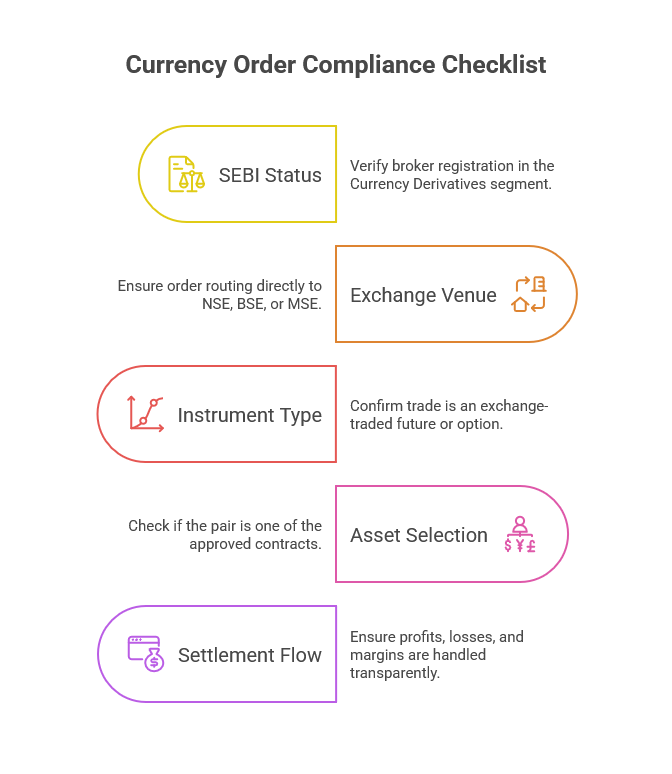
Before you execute your next currency order, verify your compliance against this checklist:
- [ ] SEBI Status: Is the broker explicitly registered in the Currency Derivatives segment?
- [ ] Exchange Venue: Is the order routing directly to the NSE, BSE, or MSE order books?
- [ ] Instrument Type: Is the trade an exchange-traded future or option contract? (No spot trades, no CFDs)
- [ ] Asset Selection: Is the pair one of the 4 INR-paired or 3 approved cross-currency contracts?
- [ ] Settlement Flow: Are all profits, losses, and margins handled transparently in Indian Rupees (INR)?
Risk Management and Tax Compliance for Indian Forex Traders
Operating within the legal framework is just the start; surviving the market requires a rigorous understanding of systemic risk and fiscal liabilities.
Tax on Currency Derivative Gains: Business Income Rules
Profits generated from trading currency futures and options on domestic Indian exchanges are not classified as capital gains. Instead, under the Income Tax Act of India, gains from currency derivatives are classified and taxed as Business Income.
- Non-Speculative Business Income: Because exchange-traded currency derivatives are highly regulated, transparently cleared, and categorized as non-speculative, they can be clubbed with your regular business revenue.
- Tax Brackets: The net profit is added directly to your total individual or corporate income and taxed according to your applicable slab rates.
- Loss Set-Offs: A distinct benefit of the legal framework is that any losses incurred in currency trading can be set off against other non-speculative business profits and carried forward for up to eight subsequent financial years, provided you file your Income Tax Return (ITR) within the statutory timeline.
Mitigating Volatility with Stop-Loss and Position Sizing
Currency markets are highly vulnerable to sudden macroeconomic announcements, interest rate decisions by central banks, and geopolitical friction. Because exchange-traded derivatives operate with systemic leverage, a small adverse move can wipe out your trading margins quickly if unmanaged.
- Hard Stop-Losses: Always embed an automated hard stop-loss order with every position opened. Never rely on manual execution during high-impact news events when spreads can widen momentarily.
- The 1% Risk Rule: Never risk more than 1% to 2% of your total trading capital on any single contract setup. If your account holds ₹5 Lakhs, your maximum loss exposure on a failed trade should never cross ₹5,000.
Operational Safeguards for Retail Currency Traders
Real-World Example: Consider an Indian exporter who expects a large USD payment in three months. If the Rupee appreciates significantly in that time, the exporter will receive fewer Rupees upon conversion, damaging their operating margins. To mitigate this risk legally, the exporter buys USD/INR futures contracts on the National Stock Exchange (NSE) through a SEBI-registered broker. If the Rupee strengthens, the loss in their actual business invoice is neatly offset by the financial profits gained on their exchange-traded futures position. This is the exact, legitimate utility of the Indian currency derivatives market.
Building a Compliant Digital Presence for Your Financial Brand
Navigating complex financial laws requires extreme clarity, not just for individual traders, but also for the businesses, financial advisory groups, and fintech applications serving them. If you operate a brand in the financial, banking, or brokerage space, establishing absolute trust and regulatory clarity online is critical to attracting high-value users.
At fxorbits, we specialize in designing premium, enterprise-grade WordPress websites and executing high-impact technical SEO strategies specifically tailored for financial service brands and modern growth companies. We have successfully helped over 80+ businesses globally scale their digital presence, capture targeted organic traffic, and establish authoritative domain positions.
Frequently Asked Questions (FAQs)
Is it illegal to use apps like OctaFX or Olymp Trade in India?
Yes, using offshore retail apps like OctaFX, Olymp Trade, or IQ Option for forex trading is illegal for Indian residents. These entities are explicitly listed on the RBI Alert List because they are not registered with SEBI and facilitate unauthorized spot forex trading outside domestic exchanges.
Can I legally trade the EUR/USD pair in India?
Yes, but you can only trade EUR/USD as an exchange-traded derivative contract on recognized domestic exchanges like the NSE or BSE through a SEBI-registered broker. Trading EUR/USD as spot forex or via a margin account on an overseas platform remains completely prohibited.
What happens if I get caught trading forex illegally?
If caught trading forex through unauthorized platforms, you can face severe enforcement actions under Section 13 of FEMA. This includes financial penalties up to three times the total transacted amount, automated bank account freezes, and potential investigation notices from the Directorate of Enforcement.
Can I send money abroad using LRS to fund a forex account?
No, you cannot. The RBI’s Liberalised Remittance Scheme explicitly prohibits the remittance of funds outside India for speculative purposes, margin calls, or funding overseas trading accounts. Doing so is a direct violation of FEMA exchange control guidelines.
Are profits from legal currency trading taxable in India?
Yes, profits from exchange-traded currency derivatives are treated as non-speculative business income under the Income Tax Act. These gains are added to your total income and taxed according to your individual or corporate tax slabs, allowing you to offset related trading expenses.
Where can I find the official list of banned forex brokers?
The Reserve Bank of India continuously updates and publishes its official “Alert List” on its main website (rbi.org.in). This public register lists all unauthorized electronic trading platforms and offshore entities that are banned from operating or marketing inside India.
Which exchanges are authorized for forex trading in India?
Only three recognized domestic stock exchanges are authorized by SEBI and the RBI to offer currency derivative trading to the public: the National Stock Exchange (NSE), the Bombay Stock Exchange (BSE), and the Metropolitan Stock Exchange (MSE).
Conclusion
Understanding the rules surrounding currency is forex trading legal in India is essential for any market participant looking to build a sustainable, legally secure trading portfolio. While international spot markets remain entirely out of bounds due to strict RBI capital flight controls and FEMA mandates, the domestic exchange-traded currency derivatives segment offers a robust, highly transparent, and legally protected alternative. By sticking exclusively to SEBI-registered brokerages, trading approved INR and cross-currency contracts, and routing every transaction through local exchanges like the NSE and BSE, you can fully capitalize on currency price movements without risking heavy financial penalties or account freezes.
Whether you are a trader looking to navigate market rules or a financial business trying to present your services with complete compliance and digital authority, clarity is your ultimate asset. Ensuring your brand communicates trust effectively requires a solid digital foundation.
