

Key Takeaways
- Strictly Regulated: Forex trading in India is legal only through exchange-traded currency derivatives (Futures and Options) on SEBI-regulated exchanges like NSE, BSE, and MSE.
- Permitted Pairs: You can legally trade 4 INR pairs (USD/INR, EUR/INR, GBP/INR, JPY/INR) and 3 cross-currency pairs (EUR/USD, GBP/USD, USD/JPY).
- Offshore Platforms Are Illegal: Using international spot forex brokers or CFD apps violates FEMA regulations and can attract heavy structural penalties.
- Zero Spot Trading for Retail: Retail spot forex trading is completely prohibited; all legal trades are cash-settled in Indian Rupees (INR).
- Lower Capital Requirements: Beginners can start trading currency derivatives via local registered brokers with margins as low as ₹2,000 to ₹3,000 per lot.
- Key Risk Mitigation: Success requires thorough technical analysis, monitoring RBI monetary policies, and strictly implementing protective stop-loss orders.
Did you know that the global foreign exchange market processes over $7.5 trillion in daily volume, making it the largest financial market on earth? Yet, countless enthusiastic Indian investors dive headfirst into international trading applications, only to find their bank accounts frozen or receive legal notices from the Enforcement Directorate. The allure of making money through currency fluctuations is undeniable, but navigating the regulatory minefield in India requires specific, up-to-date knowledge.
The core challenge for Indian retail investors is the unique regulatory framework that governs local markets. Unlike western countries where margin-based spot trading is standard, India treats foreign exchange with extreme caution to protect its domestic currency stability and manage capital outflows.
If you are wondering how to safely navigate this ecosystem, you have come to the right place. This comprehensive guide will demystify Forex Trading in India, map out the legal boundaries under the latest 2026 Reserve Bank of India (RBI) updates, and provide an actionable roadmap to help you trade currency pairs securely and profitably.
The Legal Framework: Is Forex Trading Legal in India?
The most critical question every beginner must ask before placing their first trade is: Is Forex Trading Legal in India? The short answer is yes, but with major, non-negotiable restrictions. Unlike traditional equity trading, currency trading operates under strict legislative oversight.
Understanding FEMA and RBI Regulations
Foreign exchange transactions in India are strictly governed by the Foreign Exchange Management Act (FEMA), 1999. The primary objective of the Reserve Bank of India (RBI) is to maintain the stability of the Indian Rupee (INR) and prevent capital flight. Under FEMA rules, Indian residents are prohibited from remitting funds abroad for margin trading or speculative forex activities. This means funding an offshore broker account using your credit card, net banking, or crypto wallets is a direct violation of Indian law.
Exchange Traded Derivatives vs. Spot Forex
The most crucial distinction a beginner must learn is the difference between Exchange-Traded Derivatives (ETDs) and Spot Forex (or Contracts for Difference – CFDs).
- Spot Forex / CFDs: This involves buying and selling actual currencies or contract derivatives via international platforms. This is 100% illegal for Indian retail residents.
- Exchange-Traded Derivatives: This involves trading standardized currency Futures and Options contracts listed on recognized Indian stock exchanges. This is 100% legal.
Penalties for Non Compliance
The RBI maintains an updated “Alert List” of unauthorized electronic trading platforms. Engaging with these banned offshore applications can result in severe legal consequences under Section 13 of FEMA. Violators can face structural penalties up to three times the amount involved in the transaction or a fixed penalty of up to ₹2 Lakhs, alongside potential bank account freezes.
Permitted Currency Pairs in India
To ensure you stay completely on the right side of the law while executing currency trading in India, you must restrict your activities exclusively to the asset pairs approved by the Securities and Exchange Board of India (SEBI).
Rupee Based Currency Pairs (INR Pairs)
SEBI permits retail traders to trade four primary currency pairs that are paired directly against the Indian Rupee. These are the most liquid contracts on domestic exchanges:
- USD/INR: US Dollar vs. Indian Rupee (The most liquid and actively traded pair)
- EUR/INR: Euro vs. Indian Rupee
- GBP/INR: British Pound vs. Indian Rupee
- JPY/INR: Japanese Yen vs. Indian Rupee (Quoted per 100 Yen)
Permitted Cross Currency Pairs
In addition to the Rupee centric pairs, Indian exchanges also list specific international cross-currency derivatives. However, remember that these are still traded as exchange contracts and are ultimately cash-settled in INR:
- EUR/USD: Euro vs. US Dollar
- GBP/USD: British Pound vs. US Dollar
- USD/JPY: US Dollar vs. Japanese Yen
Prohibited Currency Pairs
Any pair that does not involve the contracts listed above is illegal for Indian retail traders. You cannot trade exotic pairs or major pairs like AUD/USD, USD/CAD, or NZD/USD through any platform if you are an Indian resident.
| Currency Pair Type | Allowed Pairs | Trading Mechanism | Legal Status |
| INR Pairs | USD/INR, EUR/INR, GBP/INR, JPY/INR | National Exchanges (NSE, BSE) | Legal |
| Cross-Currency Pairs | EUR/USD, GBP/USD, USD/JPY | National Exchanges (NSE, BSE) | Legal |
| Global Spot / CFDs | AUD/USD, EUR/GBP, USD/CAD, etc. | Offshore Apps / Brokers | Illegal |
How the Forex Market in India Works
The forex market India operates differently from the global 24/5 decentralized market. Understanding its localized mechanics is vital for structured capital deployment.
Trading Hours on Indian Exchanges
While the international forex market runs continuously, the currency derivatives segment on Indian stock exchanges has fixed operating windows. For INR-based pairs, trading typically occurs between 9:00 AM and 5:00 PM IST, Monday to Friday. However, for cross-currency pairs (like EUR/USD), the trading window is extended up to 7:30 PM IST to align better with global market volumes.
Mechanics of Currency Futures and Options
When you trade forex legally in India, you are using derivative contracts:
- Futures Contracts: An agreement to buy or sell a specific currency pair at a predetermined price on a specified future date. Every contract has a fixed expiry date (typically the last working day of the month).
- Options Contracts: Giving the trader the right, but not the obligation, to buy (Call Option) or sell (Put Option) a currency contract at a specific strike price.
Margin Requirements and Lot Sizes
Unlike international brokers offering crazy leverage ratios like 1:500 (which wipe out retail accounts in seconds), SEBI mandates sensible margin systems. For instance, the lot size for a USD/INR contract is $1,000. However, you do not need $1,000 to trade it. You only need to pay an initial margin (usually around 2% to 3%), which translates to roughly ₹2,000 to ₹3,000 per lot.
Actionable Tip: Always check the exchange margin calculator provided by your domestic broker before entering a trade. If you hold positions overnight, ensure you have an extra buffer to handle potential Mark-to-Market (MTM) margin calls driven by unexpected global news.
Step-by-Step Guide: How to Start Forex Trading in India
Ready to begin your journey? If you want to know how to start forex trading in India efficiently without hitting legal blocks, follow this compliant step-by-step framework.
Step 1: Select a SEBI-Registered Domestic Broker
                   ↓
Step 2: Open and Activate the Currency Derivatives Segment
                   ↓
Step 3: Complete KYC Verification via PAN & Aadhaar
                   ↓
Step 4: Deposit Capital using Approved Indian Bank Accounts
                   ↓
Step 5: Analyze and Execute Your First Legal Currency Trade
Select a SEBI Registered Broker
Your very first step is to pick an authorized domestic broker. Avoid any app advertised on social media that promises instant dollar deposits via UPI into an offshore account. Stick to trusted institutional or discount brokers holding active SEBI clearings for the currency segment.
Enable the Currency Derivatives Segment
If you already possess an active stock trading account, the currency segment might not be active by default. You will need to log into your broker’s portal, navigate to segment activation, and submit an income proof document (such as a recent 6-month bank statement, salary slip, or ITR acknowledgment) to unlock currency futures and options trading.
Fund Your Account and Place Orders
Once activated, transfer funds into your trading account directly from your linked Indian bank account. To buy or sell a contract, pull up the ticker on your terminal (e.g., “USDINR2026FEBFEB” for a February futures contract), select the number of lots, specify your order type (Market or Limit), and execute the trade.
Choosing the Best Forex Trading Platform in India
Finding the best forex trading platform in India comes down to looking at technological reliability, charting tools, execution speeds, and fee transparency.
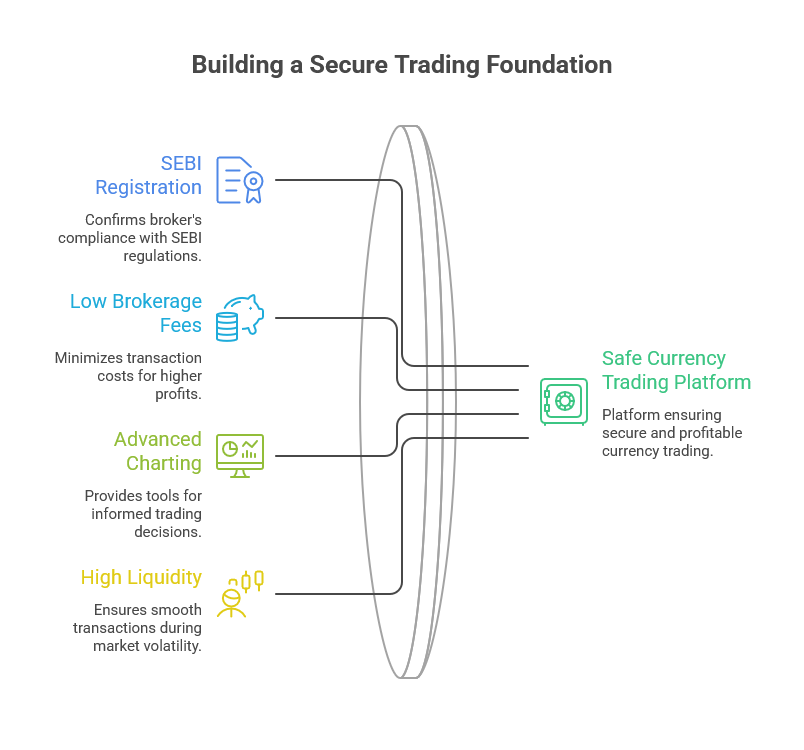
Criteria for Choosing a Safe Platform
- SEBI Registration: Verify the broker’s registration number on the official SEBI directory.
- Low Brokerage Fees: Since currency movements are measured in tiny increments, high transaction fees can eat into your profits. Look for flat-fee or low-percentage structures.
- Advanced Charting Capabilities: Ensure the platform offers built-in Technical Indicators, candlestick charts, and drawing tools.
- High Liquidity and Order Execution: Choose platforms with large active user bases to avoid slippage issues during volatile market hours.
Top Regulated Options in India
Several top-tier discount and full-service brokers offer robust ecosystems to learn forex trading in India safely. Platforms like Zerodha, Groww, Angel One, and Upstox provide seamless user interfaces, zero-cost educational modules, and direct access to NSE and BSE currency segments with flat brokerage fees (typically ₹20 per executed order).
Forex Trading Strategies for Beginners
To survive the volatile world of exchange rates, relying on gut feelings is a recipe for disaster. You need structured, data-tested forex trading strategies for beginners to protect your capital.
Support and Resistance Breakout Strategy
This strategy focuses on identifying psychological price barriers where a currency pair historically reverses or breaks through with high volume.
- How it works: If the USD/INR contract repeatedly hits a ceiling at 83.50 and drops, 83.50 is the Resistance level. If global factors push the price cleanly above 83.50, traders enter a “Long” (Buy) position, anticipating a rapid continuation upward.
Moving Average Crossover
A classic technical strategy that uses smooth price trend lines to identify macro direction changes.
- How it works: Plot a short-term moving average (e.g., 9-period EMA) and a long-term moving average (e.g., 21-period EMA) on your 15-minute or 1-hour chart. When the 9 EMA crosses above the 21 EMA from below, it generates a bullish signal. Conversely, crossing below indicates a bearish trend.
Fundamental News Trading
Because currency values reflect national economic health, tracking major macroeconomic announcements is vital for a comprehensive forex trading guide 2026.
- Key data points to track: US Federal Reserve Interest Rate Decisions, RBI Monetary Policy Committee (MPC) meetings, Non-Farm Payroll (NFP) employment reports from the US, and national Consumer Price Index (CPI) inflation rates.
Essential Risk Management and Trading Tips
Even the most accurate technical strategy will fail without proper risk controls. Implement these foundational forex trading tips for beginners to preserve your hard-earned trading capital over the long run.
The Power of the Stop Loss Order
A stop-loss order is an automated instruction given to your broker platform to liquidate your open position once the asset hits a specific adverse price threshold. Never, under any circumstances, execute an open currency derivative trade without setting a definitive stop-loss order. It acts as your ultimate financial safety net against sudden global market shocks.
Calculating Risk-to-Reward Ratios
Before taking a trade, determine exactly how much money you are willing to lose versus how much you aim to gain. A professional baseline is a 1:2 Risk-to-Reward ratio. This means if your calculated stop-loss exposes you to a potential loss of ₹500 on a lot, your target profit level must be set to at least ₹1,000. With this mathematical structure, even if you lose half of your trades, you will remain net profitable.
Controlling Emotional Leverage
Because currency contracts are leveraged, it is easy for beginners to over-trade. If your account capital is ₹50,000, do not utilize your entire margin limit to open 15 lots simultaneously. Stick to risking a tiny fraction—ideally 1% to 2% of your net capital on any single trading setup.
Taxation on Forex Trading Profits in India
Understanding the fiscal liabilities of your financial actions is just as crucial as learning how to trade. Forex trading profits in India do not fall under capital gains; instead, they are classified as business income.
Speculative vs. Non-Speculative Business Income
Because exchange-traded currency derivatives are cash-settled contracts traded on authorized national exchanges, the Income Tax Department of India treats these profits as Non-Speculative Business Income. This classification is advantageous because it allows you to offset any trading losses against other business incomes (excluding salary income).
Applicable Tax Slabs
Your net net profits accumulated from currency derivative trading over the financial year are aggregated with your overall personal income. Taxation is computed based on the standard individual Income Tax Slab Rates you fall under (whether under the Old Tax Regime or the New Tax Regime).
Maintaining Records for Tax Filings
It is highly recommended to download your consolidated P&L statements and contract notes directly from your domestic broker dashboard at the end of every fiscal year. If your trading turnover exceeds the threshold limits specified under the Income Tax Act, you may also need to undergo a mandatory tax audit under Section 44AB. Seeking professional guidance from a Chartered Accountant (CA) ensures you file your ITR-3 or ITR-4 forms flawlessly.
Accelerating Your Business Growth Digitally
Mastering complex financial landscapes like forex trading takes dedication, precision, and reliable structural data—qualities that also determine whether a modern business succeeds online. If you are operating an enterprise, launching a financial consulting platform, or scaling a local service entity, simply having a website isn’t enough anymore; you need a high-converting digital storefront that ranks natively at the top of search engines.
At fxorbits, we specialize in crafting custom, high-performance WordPress web designs and execution-driven SEO blueprints tailored to your distinct niche. As an elite agency based in Noida, India, our expert team has successfully empowered over 80 businesses globally to maximize their organic footprint, scale lead conversion funnels, and capture target audiences effectively. Whether you are building an interactive financial blog or scaling an enterprise platform, let us transform your digital presence into a measurable growth engine.
Frequently Asked Questions (FAQs)
Is forex trading completely legal in India?
Yes, forex trading is completely legal in India, but it is heavily restricted. You can only trade exchange-traded currency derivatives (Futures and Options) through SEBI-registered domestic brokers. Trading spot forex or using unauthorized offshore platforms is illegal under FEMA guidelines.
Can I use international apps like OctaFX or Olymp Trade?
No, using international apps like OctaFX, Olymp Trade, or IQ Option is illegal for Indian residents. The Reserve Bank of India (RBI) explicitly lists these platforms on its official ETP Alert List because they violate FEMA regulations by transferring margins offshore.
What currency pairs can I legally trade in India?
You can legally trade four currency pairs paired against the Indian Rupee: USD/INR, EUR/INR, GBP/INR, and JPY/INR. Additionally, SEBI allows trading in three specific cross-currency pairs on national exchanges: EUR/USD, GBP/USD, and USD/JPY.
How much money do I need to start currency trading?
You can start legal currency trading in India with very minimal capital. Because domestic exchanges operate on structured margin systems, you only need to pay an initial margin of about 2% to 3%, which amounts to roughly ₹2,000 to ₹3,000 to trade one lot of USD/INR.
What are the market timings for forex trading in India?
For standard INR-based currency pairs, the trading hours on Indian exchanges (NSE and BSE) are from 9:00 AM to 5:00 PM IST, Monday through Friday. For cross-currency pairs like EUR/USD, the trading window extends up to 7:30 PM IST.
Do I need a demat account for forex trading?
You do not strictly require a Demat account to store currency assets, as forex derivatives are cash-settled and do not involve physical delivery. However, you will need an active Trading Account with a SEBI-registered broker that has the Currency Derivatives segment enabled.
How are forex trading profits taxed in India?
Profits from legal currency derivatives trading are treated as Non-Speculative Business Income by the Income Tax Department. These gains are added to your total annual income and taxed according to your applicable individual income tax slab rates.
Conclusion
Navigating the landscape of Forex Trading in India can be a highly lucrative endeavor if you respect the regulatory framework put in place by regulatory authorities. By steering clear of deceptive offshore spot trading applications and focusing your capital on legal, exchange-traded currency derivatives via SEBI-registered brokers, you protect both your hard-earned money and your legal standing. Success in the currency markets requires continuous education, disciplined technical strategy implementation, and rigorous risk control practices.
Ensure you treat currency trading as a data-driven business rather than a casual gamble. Master your technical indicators, stay updated on global macroeconomic policy changes, always deploy a protective stop-loss order, and scale your lot sizes carefully as your trading expertise evolves.
Ready to build a powerful online presence for your own brand or financial venture? Contact fxorbits today for a free SEO consultation.
