
Key Takeaways
- Regulatory Disconnect: Retail spot forex and CFDs operate in a regulatory grey area for Indian residents; legal trading is limited to Exchange-Traded Currency Derivatives (ETCDs) on national exchanges.
- Top Tier-1 Regulated Choices: International platforms like Interactive Brokers provide direct, fully compliant SEBI-approved options for currency derivative segments.
- Offshore Low-Spread Solutions: Popular multi-regulated brokers like Pepperstone, TMGM, and IC Markets provide raw ECN accounts with spreads starting from 0.0 pips for international markets.
- Beginner Safety Focus: Newer traders should look for platforms with localized educational suites and risk management tools like AvaProtect to safeguard volatile currency trades.
- Fee Clarity Matters: Hidden costs like overnight swap fees and currency conversion marks can deeply erode short-term intraday profits if not systematically compared.
- Secure Funding Mechanisms: While international brokers accept alternative payment gateways, funding accounts via unauthorized channels carries significant legal risks under the Foreign Exchange Management Act (FEMA).
Navigating the global currency market from India can feel like trying to solve a complex puzzle while walking a legal tightrope. Forex trading offers massive liquidity and 24-hour market access, but for Indian retail traders, finding the best forex brokers in India is not as simple as clicking a sign-up button. The Indian regulatory landscape has distinct boundaries managed by the Securities and Exchange Board of India (SEBI) and the Reserve Bank of India (RBI). Trading without an understanding of these boundaries can expose your hard-earned capital to severe compliance risks or unreliable offshore entities.
To achieve sustainable success, you need a trading partner that balances competitive pricing, advanced technology, and capital security. This guide breaks down the top platforms available to Indian residents, comparing everything from institutional-grade execution speeds to raw ECN accounts. Whether you are searching for the best forex broker for beginners India or a low-spread platform for algorithmic scaling, you will find a clear analysis here. Let’s look at the operational parameters, legal guardrails, and platform features shaping the Indian forex market in 2026.
Understanding the Indian Forex Regulatory Framework
The Dual Role of SEBI and RBI
The financial landscape in India operates under strict, centralized supervision to protect retail investors and stabilize the national currency. SEBI acts as the primary regulatory watchdog for market operations, licensing local clearing houses and broking entities. Concurrently, the RBI dictates macroeconomic policy, directly controlling cross-border capital flows and foreign exchange reserves. When you trade currencies within India, your broker must comply with the overlapping rules issued by both institutions.
Exchange-Traded Currency Derivatives (ETCDs)
To trade with absolute legal backing, Indian residents must use SEBI approved forex brokers to trade Exchange-Traded Currency Derivatives (ETCDs). These contracts are cleared through major domestic national bodies like the National Stock Exchange (NSE) and the Bombay Stock Exchange (BSE). Unlike retail spot forex, where you trade directly against a broker’s internal liquidity pool, ETCDs are standardized futures and options contracts executed transparently on an open exchange order book.
FEMA Guidelines and Legal Cross-Border Boundaries
The Foreign Exchange Management Act (FEMA) explicitly prohibits Indian residents from transferring money outside the country for speculative margins or retail spot currency trading. Sending domestic funds to unregulated offshore entities via international credit cards or unverified digital wallets is a direct violation of these capital control laws. If you choose to interact with global regulated forex brokers India, you must limit your activities to non-speculative investments or utilize compliant frameworks like the Liberalised Remittance Scheme (LRS) for allowable asset classes, which excludes retail leverage.
| Regulatory Element | SEBI/RBI Approved ETCDs | Offshore Retail Spot Forex |
| Legal Status | Fully Authorized and Legal | Operates in a Regulatory Grey Area |
| Permitted Pairs | INR-pairs (USD/INR, EUR/INR) + select cross pairs | Any global cross or exotic pair |
| Execution Venue | Public Exchanges (NSE / BSE) | Over-The-Counter (OTC) / Broker’s Pool |
| Max Leverage | Highly limited by exchange margins | Up to 1:500 or higher via offshore entities |
Methodology: How We Review Forex Platforms
Assessment of Global Tier-1 Regulatory Licenses
When compiling our forex broker reviews India 2026, our primary criteria is the quality of the regulatory licenses held by each broker. We prioritize firms monitored by strict, Tier-1 global financial bodies. These include the Australian Securities and Investments Commission (ASIC), the Financial Conduct Authority (FCA) of the UK, and the Cyprus Securities and Exchange Commission (CySEC). A broker possessing these credentials is bound to maintain segregated client bank accounts and undergo regular third-party audits.
Evaluating Raw Spreads and Execution Latency
For active daily traders, the spread is the most critical variable cost. We isolate the lowest spread forex brokers India by tracking real-time data feeds across standard and raw ECN accounts. We also analyze trade execution latency, measured in milliseconds. Sub-50 millisecond speeds are vital to avoid slippage—the discrepancy between your requested order price and the actual execution price during periods of high volatility.
Evaluating Indian Client Onboarding and Payment Channels
A high-quality platform must offer a localized, frictionless deposit and withdrawal workflow. We test how easily Indian residents can fund their accounts, verifying whether the platform supports net banking, localized payment solutions, or standard bank wires without hitting regulatory friction. Furthermore, we assess the availability of dedicated local-language customer support teams operating across Indian Standard Time (IST) business hours.
Top SEBI-Approved Options for Institutional Security
Interactive Brokers (IBKR India)
For retail traders who refuse to compromise on legal compliance, Interactive Brokers stands as a highly reliable benchmark. Operating with an explicit local footprint under SEBI licensing, IBKR provides institutional-grade access to the Indian currency derivative segment. It is built specifically for professional, systematic traders who require deep analytical tools.
- Trading Engine: Powered by the comprehensive Trader Workstation (TWS) desktop platform.
- Asset Availability: Limited strictly to legal ETCD pairs on the NSE and BSE for Indian domestic accounts.
- Pricing Model: Transparent tiered commission structure with exceptionally low spreads matching the direct exchange order book.
Traditional Domestic Brokerages (HDFC & Kotak Securities)
Major banking institutions like HDFC Securities and Kotak Securities provide a straightforward path to domestic currency trading. They do not support high-leverage spot trading or MT4/MT5 platforms, but they excel in cross-asset convenience. By tying currency trading to your existing domestic 3-in-1 bank, demat, and trading account, they simplify your annual tax reporting and eliminate regulatory compliance headaches.
Actionable Tip: If your strategy is centered on long-term macro shifts involving the Indian Rupee (INR), stick to SEBI-regulated platforms. You trade with lower systemic risk, and your capital is fully backed by local investor protection funds.
Best Global Low-Spread and ECN Brokers
Pepperstone
Pepperstone is recognized globally for its high-performance ECN (Electronic Communication Network) model. For experienced Indian market participants, Pepperstone bridges the gap between retail trading and institutional liquidity. By sourcing pricing directly from top-tier global banks, it eliminates broker intervention and conflicts of interest.
- Spreads: Raw accounts consistently display 0.0 pips on primary currency pairs like the EUR/USD, accompanied by a small, transparent commission fee.
- Platform Integrations: Full support for TradingView, MetaTrader 4, MetaTrader 5, and cTrader.
- Regulatory Shield: Monitored across multiple global jurisdictions, including ASIC and FCA.
IC Markets
IC Markets is optimized for automated algorithmic traders, scalpers, and high-frequency market participants. Its infrastructure is built around ultra-low execution latency, with its primary servers located in major global data centers like Equinix NY4 in New York. This physical optimization minimizes order execution times, keeping them at an average of under 40 milliseconds.
[Retail Trade Placement]
           │
           ▼ (Latency < 40ms)
[IC Markets Equinix Infrastructure]
           │
           ▼ (Raw Pricing Feed)
[Top-Tier Global Interbank Liquidity]
- Automated Trading: No restrictions on Expert Advisors (EAs), scalping strategies, or continuous hedging.
- Pricing Depth: True deep-book liquidity prevents artificial spread widening when high-impact economic news drops.
Best Forex Brokers in India for Beginners
TMGM (Traders Market Global Market)
TMGM stands out as an excellent, versatile choice for individuals stepping into the international currency space. It effectively combines structural simplicity with comprehensive educational tools. This balanced environment allows beginners to build confidence without feeling overwhelmed by professional charting tools.
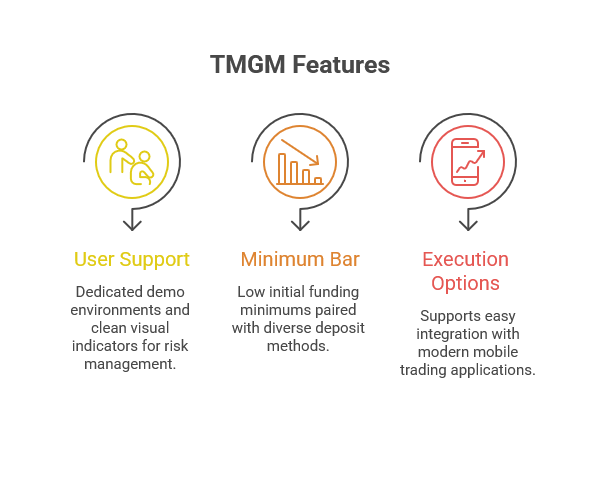
- User Support: Offers dedicated demo environments and clean visual indicators for risk management.
- Minimum Bar: Low initial funding minimums paired with diverse deposit methods.
- Execution Options: Supports easy integration with modern mobile trading applications.
AvaTrade
AvaTrade is an ideal fit for conservative beginners who prioritize active downside protection. It provides unique risk-mitigation features alongside its proprietary web interface.
- AvaProtect: A proprietary insurance feature that allows traders to protect a specific trade against losses for a small upfront fee.
- Educational Ecosystem: Extensive video modules, platform walkthroughs, and clear market breakdowns via SharpTrader.
- Copy Trading Access: Streamlined integration with social platforms like DupliTrade and AvaSocial, allowing beginners to observe experienced traders.
Comparing Core Trading Software and Infrastructure
MetaTrader 4 vs. MetaTrader 5
The global currency landscape relies heavily on MetaQuotes software. MetaTrader 4 (MT4) remains the undisputed choice for legacy algorithmic setups and custom indicators due to its massive historical user base. Conversely, MetaTrader 5 (MT5) offers superior execution processing speeds, a built-in economic calendar, and expanded native timeframes, making it highly suitable for multi-asset trading portfolios.
The Rise of TradingView and cTrader
Modern forex trading platforms India are increasingly adopting TradingView and cTrader interfaces. TradingView is highly regarded for its sleek design, cloud-synchronized charts, and extensive community-driven technical analysis scripts. Meanwhile, cTrader stands out for its modern layout and advanced order types, including sophisticated asynchronous order processing built specifically for ECN trading environments.
Real-World Case Study: A retail momentum trader using an automated trend-following system on an old MT4 platform experienced significant slippage during an NFP (Non-Farm Payroll) announcement. By migrating to an updated cTrader engine hosted on an ECN broker’s server, their execution delay dropped significantly, saving them valuable pips on fast-moving breakouts.
Operational Fees, Leverage, and Account Selection
Spread Architectures: Fixed vs. Variable Raw Models
Brokers generally structure their pricing through two models: standard fixed accounts or raw variable ECN accounts. Standard accounts do not charge a flat commission per trade; instead, the broker adds a markup directly to the spread. Raw accounts deliver true market spreads but charge a flat commission per side traded. If you enter multiple trades daily, a raw account will significantly reduce your total trading costs over time.
The Dynamics of Leverage and Margin Requirements
Leverage allows you to control large market positions using a small amount of capital. However, high leverage magnifies both profits and losses. International offshore platforms frequently offer leverage up to 1:500, whereas SEBI-authorized platforms restrict retail leverage to protect traders from sudden market gaps.
Swap Fees and Islamic Swap-Free Accounts
When you hold a currency position past the daily market close, you incur or earn a swap fee based on interest rate differentials. If your trading strategy involves holding positions for weeks, these daily adjustments can erode your profits. For traders who cannot pay or receive interest due to religious principles, top brokers offer Islamic Swap-Free accounts that replace ongoing interest charges with fixed administrative fees.
Strategic Technical Insight for Digital Growth
As an active market participant or business owner navigating online financial services, the digital presentation of your platform is just as critical as your execution speeds. Slow user experiences and complex application flows can drive prospective clients to competitor platforms before they ever place a trade. This principle applies equally to specialized financial brokers and expanding local service websites.
If you are looking to build a high-converting digital platform that captures local market intent, specialized web development and search optimization are essential components. Partnering with a professional team like fxorbits can help optimize your site’s performance, ensuring high visibility on competitive search engines.
Comprehensive Forex Broker Comparison India
To help you make an informed decision, this comprehensive table compares the operational features, structural costs, and regulatory settings of the top forex brokers India for 2026.
| Broker Name | Primary Regulator | Account Options | Average EUR/USD Spread | Targeted User Profile |
| Interactive Brokers | SEBI (India), SEC (US), FCA (UK) | Domestic Currency Only, Global Equities | Direct Exchange Book Spread | Compliance-focused professional traders |
| Pepperstone | ASIC, FCA, CySEC | Standard, Raw ECN | 0.0 – 0.2 pips (Raw) | Algorithmic and charting enthusiasts |
| IC Markets | ASIC, CySEC, FSA | Standard, Raw Spread | 0.02 pips (Raw) | Scalpers and automated EA users |
| TMGM | ASIC, VFSC, FMA | Edge, Classic | 0.1 pips (Edge) | Multi-asset retail traders |
| AvaTrade | Central Bank of Ireland, ASIC | Fixed Standard, Options | 0.9 pips (Fixed Standard) | Risk-averse beginners utilizing insurance |
| HDFC Securities | SEBI (India) | Integrated 3-in-1 | Exchange Specified | Long-term macro domestic investors |
Frequently Asked Questions (FAQ)
Is forex trading legally permitted in India?
Yes, forex trading is legal in India, but it is highly regulated. You must trade through SEBI-approved brokers on domestic exchanges like the NSE and BSE. Trading retail spot forex or cross-currency pairs via unauthorized offshore platforms violates FEMA guidelines.
What exactly defines a SEBI-approved forex broker?
A SEBI-approved forex broker is a financial intermediary registered with the Securities and Exchange Board of India to offer currency derivative trading. These brokers are clearing members of domestic exchanges and are limited to offering currency futures and options.
Can I utilize MetaTrader 4 or 5 platforms with Indian brokers?
Standard SEBI-approved domestic brokers do not use MetaTrader 4 or 5. They offer proprietary web platforms or mobile trading applications tailored to exchange-cleared futures. International offshore brokers support MT4/MT5 but carry distinct regulatory compliance risks for Indian residents.
Which broker provides the lowest spreads for Indian residents?
For domestic currency derivatives, Interactive Brokers and leading discount brokers offer direct exchange pricing. For international spot trading via offshore accounts, Pepperstone and IC Markets provide raw ECN accounts with spreads starting at 0.0 pips.
What is the minimum capital required to start trading forex in India?
Domestic currency futures accounts can be opened with zero minimum deposit requirements, and you can trade a single USD/INR micro-lot for a relatively small margin. International offshore platforms often allow initial deposits starting between $10 and $100.
What legal risks arise from using an unverified offshore forex broker?
If you fund an unverified offshore broker using unauthorized payment channels, you risk severe penalties from the RBI under FEMA regulations. Furthermore, if an unregulated broker freezes your funds, you have no recourse through Indian investor protection laws.
How are profits from forex trading taxed under Indian tax laws?
Profits from currency trading in India are treated as business income or capital gains, depending on your trading frequency. These profits are taxed according to your applicable personal income tax slab rates, and you must report them in your annual Income Tax Returns (ITR).
Conclusion
Succeeding in the global currency market requires balancing a well-tested strategy with a clear understanding of regulatory requirements. While offshore platforms offer tempting features like high leverage and zero-pip spreads, they operate in a complex legal framework for Indian residents under FEMA guidelines. If your priority is capital protection and strict compliance, choosing a SEBI-regulated broker focused on exchange-traded currency derivatives is your safest path. For traders looking beyond domestic markets, working with highly regulated Tier-1 international brokers ensures your capital remains segregated and protected from broker intervention.
Ultimately, the best forex brokers in India is the one that aligns with your risk tolerance, technological requirements, and financial goals. Take the time to test your strategies in a demo environment, analyze hidden transaction costs, and build a solid foundation before committing significant capital.